


TELDAP Collections







 A Slice of Wonder
Facets of Taiwan
Exhibitions


CategoriesFiles
 0
The Digital Museum of Nature & Culture
0
The Digital Museum of Nature & Culture
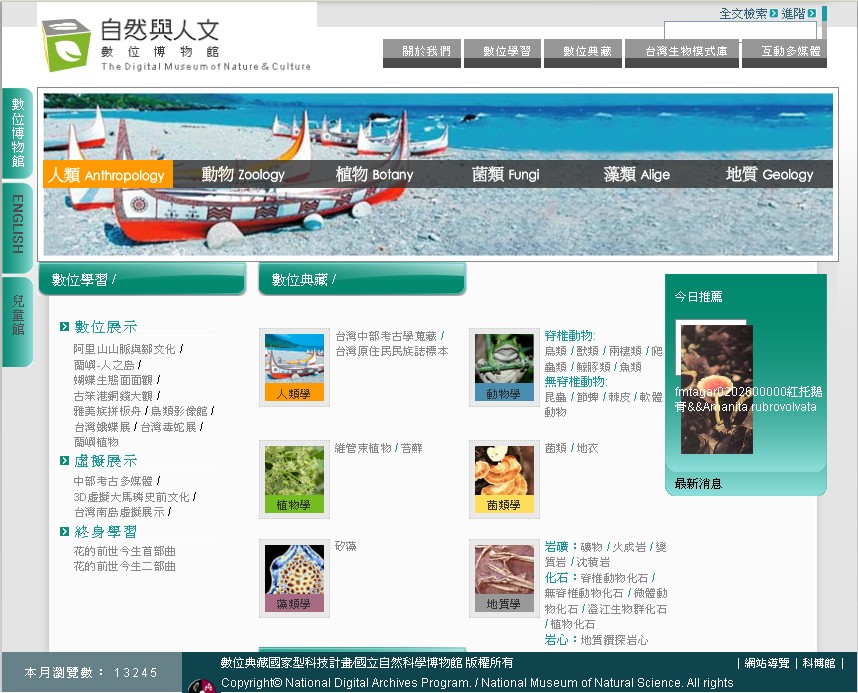 This project is a five-year project whose tasks include the digitalisation of Taiwan's precious archives and artefacts, the application of digital archives and the development of relevant information technologies. The purpose of this project is to preserve our heritage, improve the cooperation of culture and information technology, and promote industrial and economic development with these digitalised precious artefacts and archives, which are valuable materials and inspiration for many industries such as those of software, added value application, contents and culture. Furthermore, these digital contents not only improve our industrial capacity and competence, but also useful in other sections such as diplomacy, national defence, academic research, education and economy.
With this institutional project the National Museum of Natural Science will raise its capacity of operation and management and become an important centre for the production and distribution of the contents of natural and cultural history. The Museum will therefore become a national information centre of these fields and make valuable contribution to the collection, research, exhibition, education and promotion of culture. The Museum presents digital exhibitions of animals, plants, algae, fungi, geography and anthropology for educational purposes. In order to inspire innovative learning, this website provides links to other educational websites such as Archaeology in Middle Taiwan, the Tamalin Ruin, the Lives of Followers, Alishan area and Tsou Culture, Lanyu—the Isle of Man and the Stories of Butterflies.
0
Children's Digital Museum
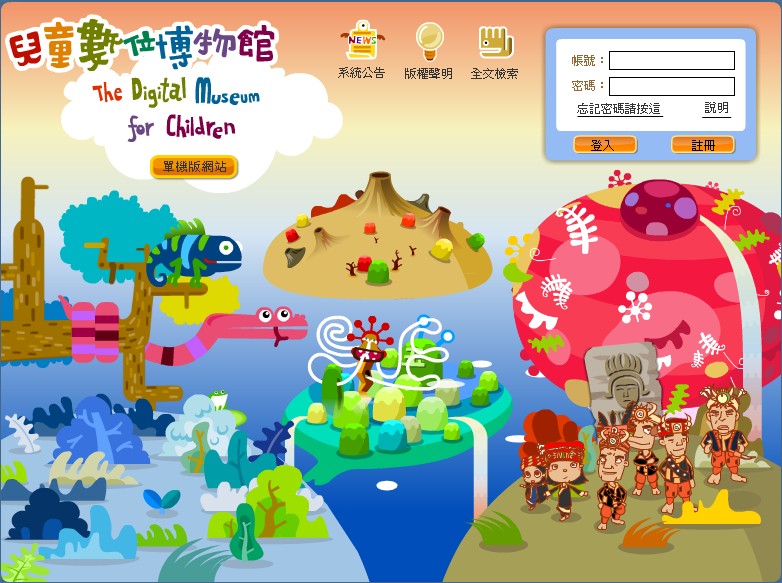 The five themes or ‘islands’ of this website are animals, plants, human beings, fungi and geology. The website has 3 main divisions: Exploration of the Isle of Sweet Potato, Forest Park and Extreme Sport Arena. It also has the following four animated exhibitions: Reptiles Roll Around, Froggy Paradise, Indigenous Music Hall, COCOBOBO Go Mining.
http://ndap.nmns.edu.tw/children/
0
Taiwan's Austronesian Peoples Virtual Exhibition
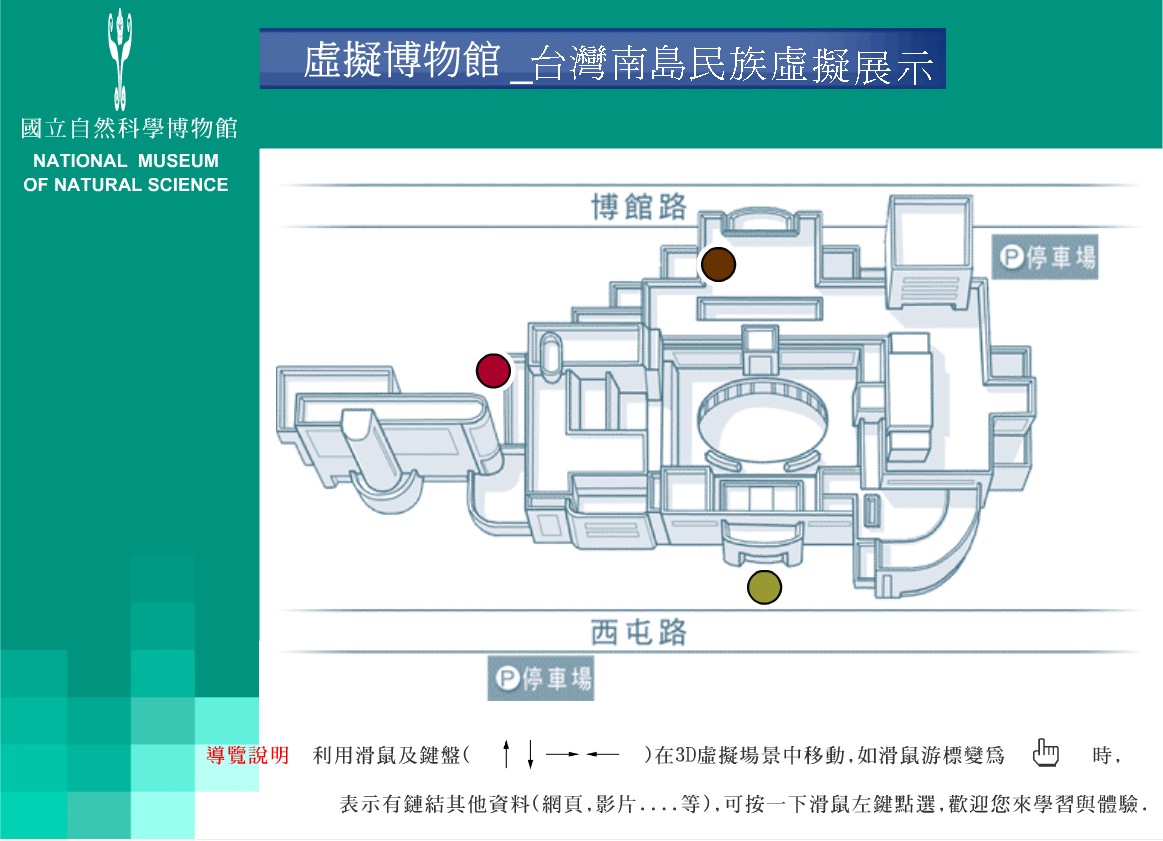 This website has three main sections: Tour of Life Science Hall, Tour of Chinese Science Hall and Global Environment Hall, and 3-D Virtual Exhibition of Taiwan's Austronesian Peoples. This website reconstructs the exhibition hall of Taiwan's Austronesian peoples with 3-D models. Besides, it also incorporates its exhibition of artefacts into its introductory sections and digital archives. Users will enjoy the virtual experience of visiting our museum without the limitation of time and location. We also provide 3-D introductory films of indigenous cultures as an alternative way of education.
http://ap-vr.nmns.edu.tw/3DWeb/NMNS/VR/vr.swf
0
Restoration of Tamalin Culture Ruin
 This website of the restored ruin of Tamalin culture aims to provide digital resources of Tamalin culture such as its location, tribes, artefacts, fishing and hunting activities, agriculture and funerals. There is also information of the Tamalin site from its early, middle to later stages of excavation as well as videos of the beautiful scenery of Puli basin.
http://digimuse.nmns.edu.tw/tamalin/
0
Anthropology Digital Museum
 This anthropology digital museum provides links to relevant on-line resources such as the 3-D virtual representation of archaeological sites in middle Taiwan, the Tamalin ruin—3D virtual reality of the Tamalin pre-historical culture, virtual exhibition of Taiwanese Austronesian peoples, Alishan area and Tsou culture, Lanyu—the Isle of Man, etc. This website also provides digital resources of ethnographical specimens of Taiwanese indigenous peoples and the middle Taiwan archaeological collections.
http://digimuse.nmns.edu.tw/aDomainIndex.jsp
0
Botany Digital Museum
 This botany digital museum provides digital resources of vascular plant (vascular plant specimens) and non-vascular plant (lichen) in the following sections: tour of knowledge database, specimen archives, exhibition by subject and multi-media programs. Its website also provides links to the websites of Lanyu-the Isle of Man, the Stories of Flowers – First Episode, Plant Exhibition, etc.
http://digimuse.nmns.edu.tw/bDomainIndex.jsp
0
Mycology Digital Museum
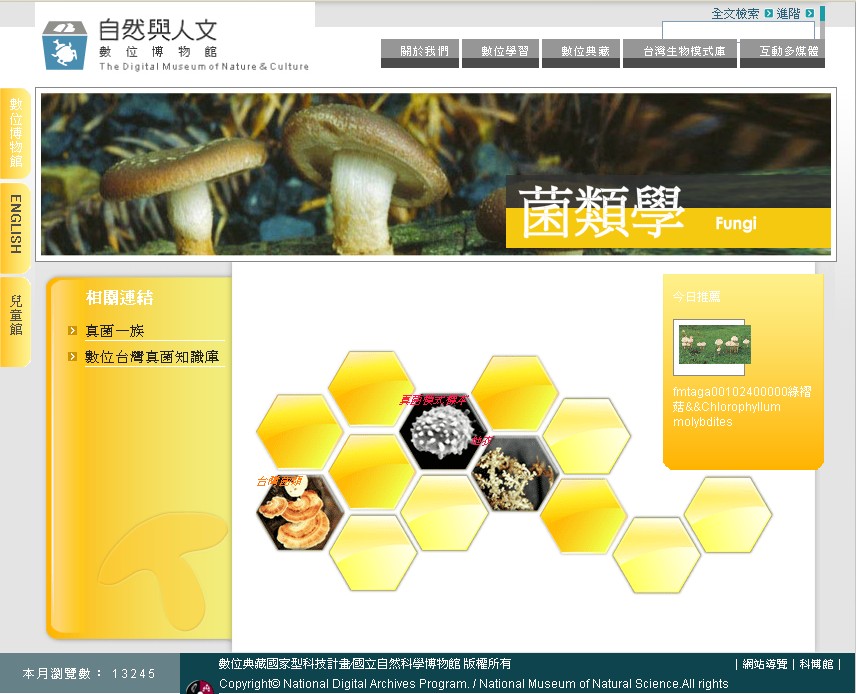 The Mycology Digital Museum provides introduction to fungi (fungous model, specimens and lichen). This website includes the following sections: tour of knowledge database, specimen archives, exhibition by subject and multi-media programs. It also has links to the website of the Family of Fungus as well as other educational websites.
http://digimuse.nmns.edu.tw/fDomainIndex.jsp
0
Algology Digital Museum
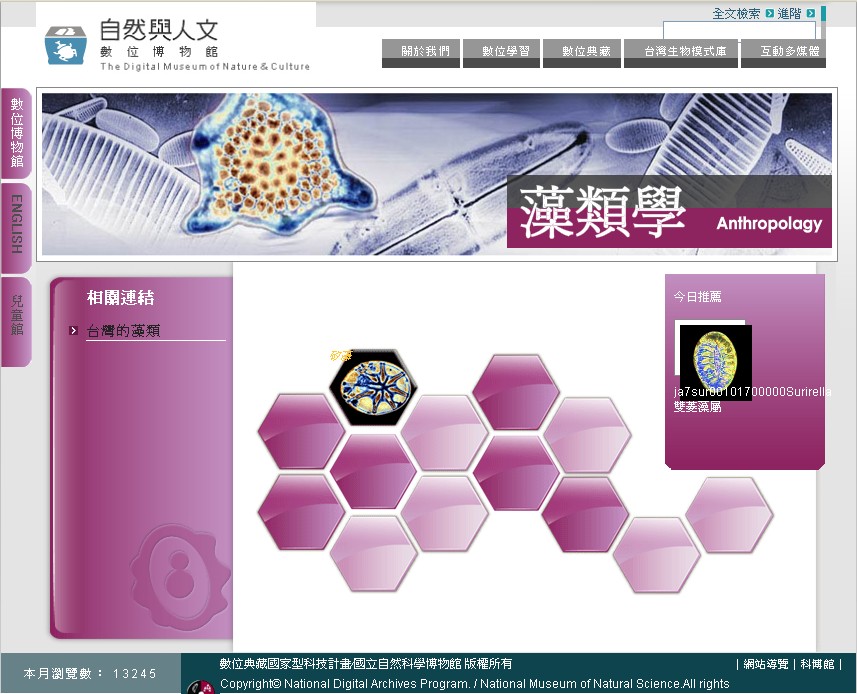 This Algology Digital Museum provides digital resources of diatom. Its website includes the following sections: tour of knowledge database, specimen archives, exhibition by subject and multi-media programs. We also provide links to Taiwan's algological websites.
http://digimuse.nmns.edu.tw/jDomainIndex.jsp
0
Geology Digital Museum
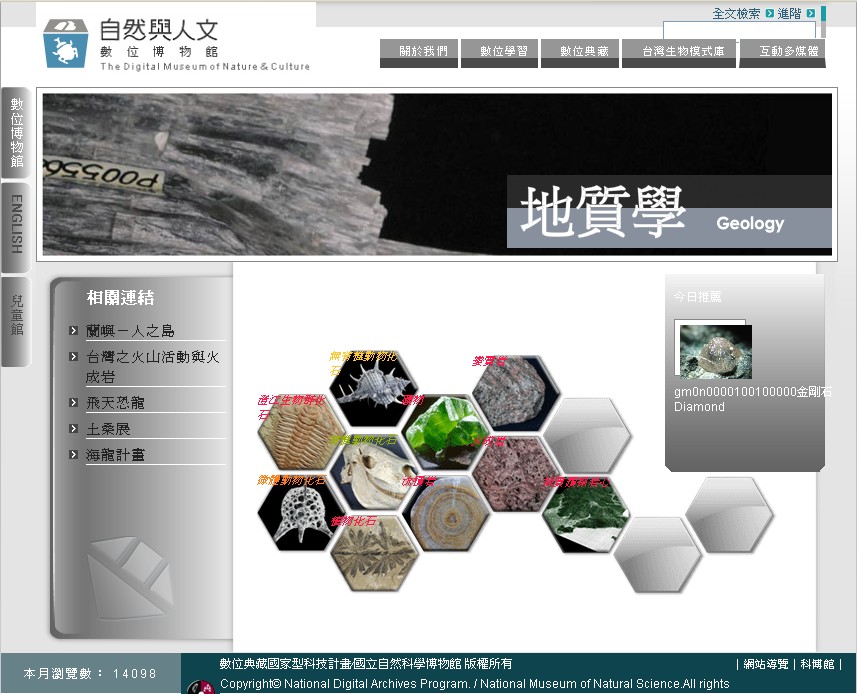 This geology digital museum provides introduction to fossils (plant fossils, Chengjiang Biota, vertebrates, invertebrates and microanimals) and ore (igneous rock, metamorphic rock, sedimentary rock and minerals) in the following sections: tour of knowledge database, specimen collections, exhibition by subject and multi-media programs.
http://digimuse.nmns.edu.tw/gDomainIndex.jsp
0
Zoology Digital Museum
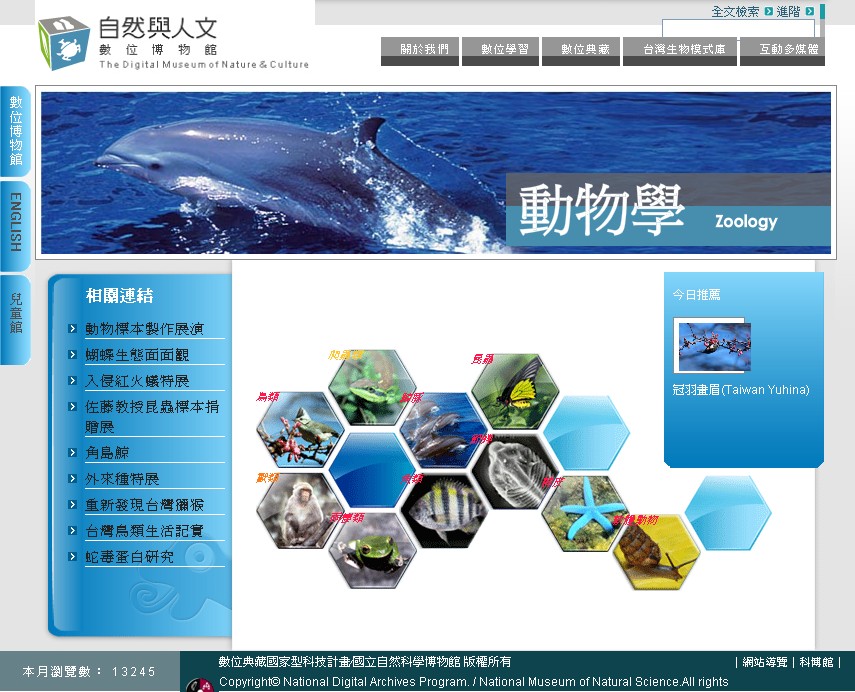 This Zoology Digital Museum provides introduction to vertebrates (reptiles, mammals, amphibians, birds, whales and fish) and invertebrates (insects, echinoderms, mites). Its content divides into the following sections: tour of knowledge database, specimen archives, exhibition by subject and multi-media programs. We have also links to relevant educational websites Animal Specimen Exhibition and Production, Butterfly Ecology, Exhibition of Red Imported Fire Ant, a Memorial of Masacaka Sato's Insect Passion, Sea Shepherd Whale, Exhibition of Imported Species, the Rediscovery of Formosan Rock-Monkey, Stories of Taiwan's Birds, Snake Venom, etc.
http://digimuse.nmns.edu.tw/zDomainIndex.jsp
0
Life Learning CD-ROM—the Life Story of Flower, First Episode
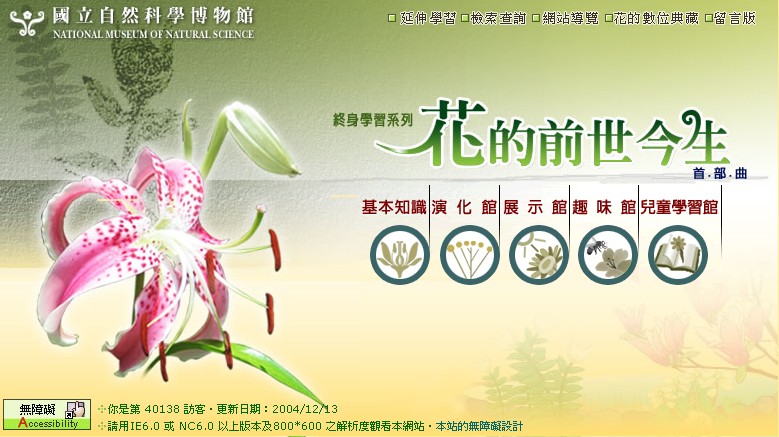 This website has the following sections: introduction, evolution, exhibition, fun activities and kids’ learning. These sections together provide preliminary and advanced information of flower structures, origins, evolution, pollination, features and legends. We also reconstruct virtual scenes of Jurassic and Cretaceous periods with 3-D animation techniques. Therefore, by using various tools such as images, interactive animation, experiments, illustrated stories and games, this website provides users with a friendly and enjoyable learning environment.
http://web2.nmns.edu.tw/flower/home.php


 visits (since January 2011)