


TELDAP Collections







 A Slice of Wonder
Facets of Taiwan
Exhibitions


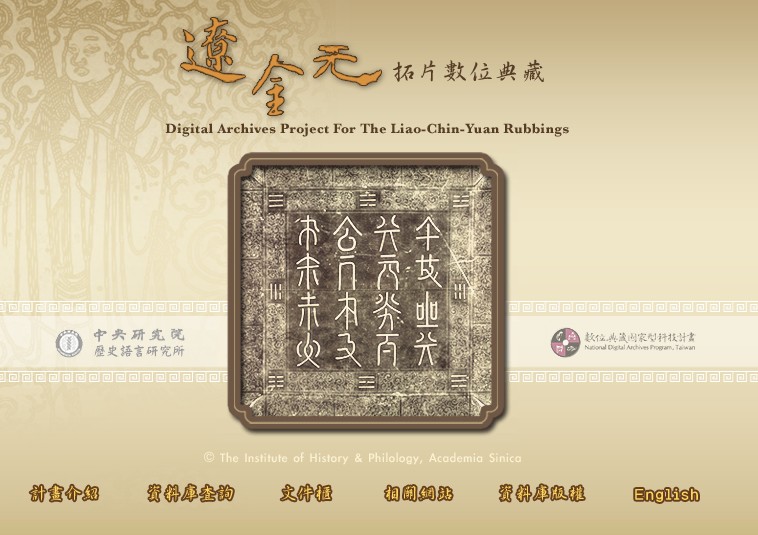 The Institute of History and Philology, Academia Sinica, has started the investigation of Fu SSu-Nien library's bronze and stone rubbings since 1995 while the Institute's collection of rubbings has been digitalised since 1990s with the launch of the National Digital Archives Program. Fu Ssu-Nine library holds about 2,000 rubbings of the Liao, Chin and Yuan dynasties. The Yuan rubbings (1260-1368) which are about 1,400 are the main part of our collection while the Liao rubbings (907-1125) are 160, and the Chin rubbings (1115-1234) are 450.
The library's rubbings are dated from 946 to 1382; however, the more exact dates of many of the rubbings are uncertain. As to their contents, these rubbings hold a wide variety of subjects including tomb inscription, headstone, carved scripture, statute, title, poetry and lyrics, Daoism, Buddhism, imperial edict, decree, law. Besides, Qidan, Jurchen and Mongolian languages which were all official languages during the Liao, Chin, or Yuan dynasties were used as commonly as the Han language. Documents and literature of those three dynasties were therefore written not only in Han but also in Qidan, Jurchen, or Mongolian. Though Fu SSu-Nien library holds only about 200 non-Han rubbings, which do not form a substantial collection, they are precious and very important materials for the study of rhyme in the Middle Age of China and the history of the Liao, Chin and Yuan dynasties.


 visits (since January 2011)