


TELDAP Collections







 A Slice of Wonder
Facets of Taiwan
Exhibitions


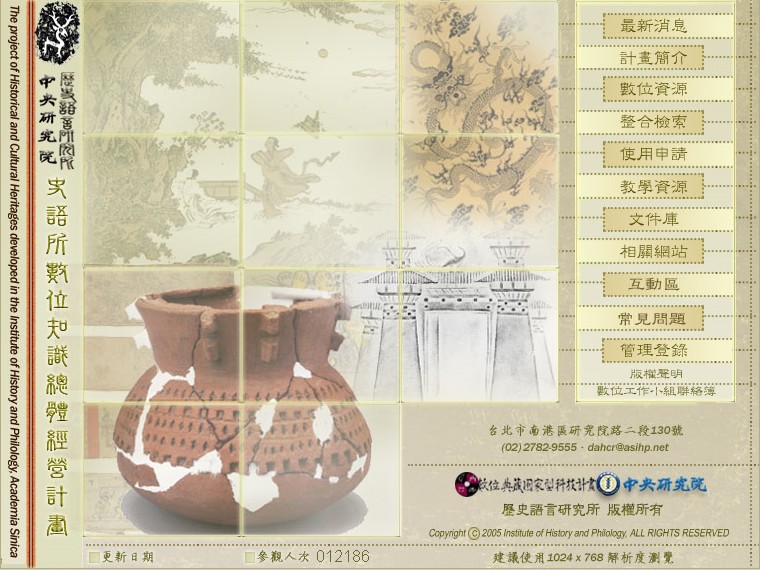 This project includes the following five sub-projects. 1.digital archives of archaeological data. 2.rubbings and archaic texts. 3. rare books of Fu Ssu-Nien Library. 4. Ethnological Specimens, photos and archives and 5. the Grand Secretariat archives. According to our investigation, the major collection of the Institute of History and Philology includes about 1,200,000 Taiwanese artefacts, 140,000 Chinese archaeological artefacts, 2,000 ethnological specimens and documents, more than 8,000 photos of field research, about 200,000 volumes of rare and antique books including folk literature, more than 310,000 items of the Ming and Ching archives, about 40,000 bronze and stone rubbings and more than 11,000 Han wooden slips.
The first stage of this project, Treasured Historical Artefacts Digital Archives based on the general goals and execution principles of the National Digital Archives Program, was one of the institutional projects under Academia Sinica and was in charge of the digitalisation of the treasured artefacts in the Institute of History and Philology. The Institute's artefacts are divided into the following main categories: archaeological materials (oracle bones, bronzes, jade, stone objects and pottery), bronze rubbings, oracle bone rubbings, tomb inscriptions of different dynasties, stele rubbings, Han stone carving rubbings, Buddhist stone carving rubbings, seals, pottery scripts, rare and antique books, the Ming and Ching archives, and the Han wooden slips from Edsengol. These various and precious collections of the Institute is due to the admirable effort of its founding director, Mr. Fu SSu-Nien and a group of young and outstanding scholars under his leadership who brought these invaluable treasures to the Institute through excavation, purchase, rescue of artefacts from human or natural destruction, field research and in every other possible way. They were said to hunt high and low, scouring cultural materials by dirtying their hands and feet. Many of these collected artefacts are valued as world-class cultural heritage of all human beings. Archaeological artefacts are scientific historical materials because they are products of field research through the rigorous procedure of which the date, location and other details of every artefact are recorded methodically. The importance of excavated objects in academic research is beyond doubt.


 visits (since January 2011)