


TELDAP Collections







 A Slice of Wonder
Facets of Taiwan
Exhibitions


CategoriesFiles
 0
Academia Sinica Digital Resources
0
Academia Sinica Digital Resources
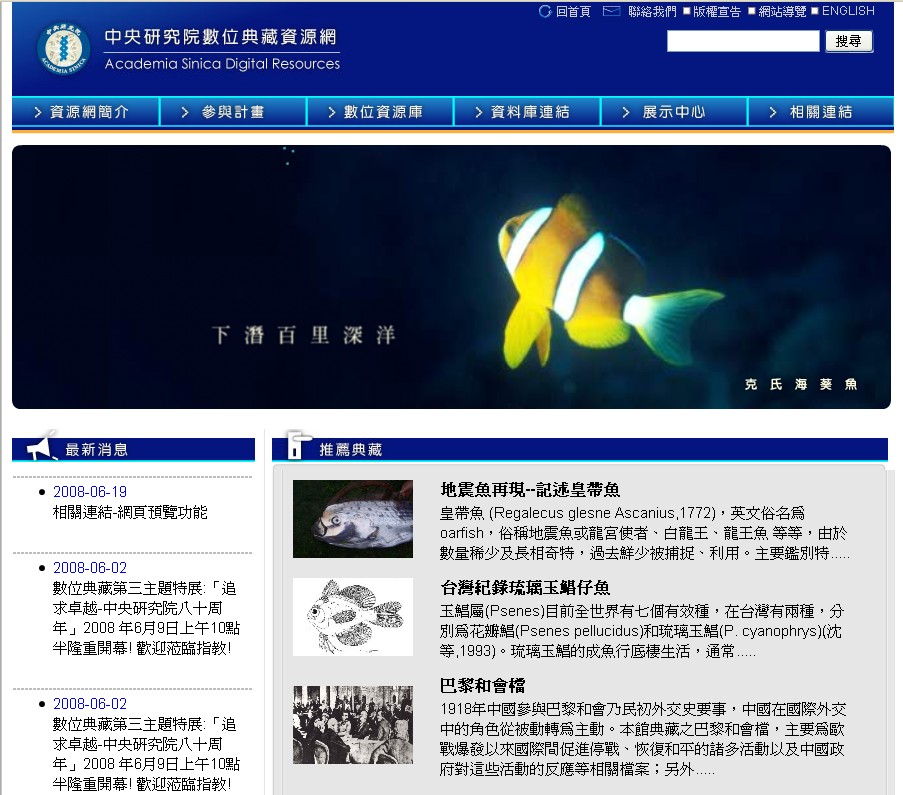 The goal of Academia Sinica Institution Project, under the National Digital Archive Program, is, in the period of five years, to digitalize and internetize special archives of Academia Sinica to achieve resource sharing. In addition to the Main Project of the Institution Project, which is in charge of coordination and management, there are nine other subprojects covering archives of plants, shellfishes, plants, maps, Formosan aborigines, the Taiwan Provincial Consultative Council, diplomatic and economic records, historical and cultural relics: archaeological data, rubbings, archaic texts, rare books, ethnological data, the Grand Secretariat Archives, and Mandarin & Formosan language archives, as well as the digital archive technology.
0
Aerial Photo Management and Retrieval System
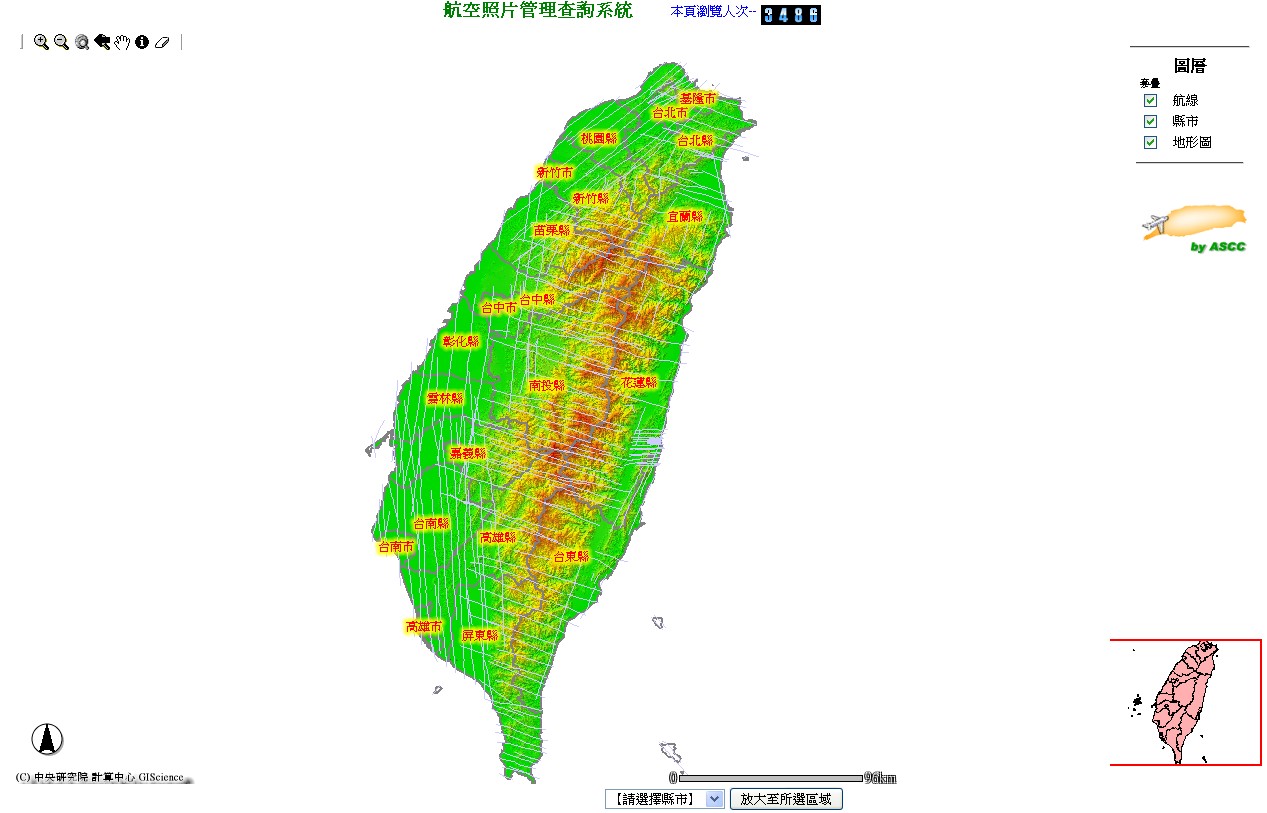 Aerial photos provide plenty of primary and authentic information of geographic surfaces. A panorama of geographic surfaces not only tell us an overall picture of a targeted object itself but also help us understand its natural and cultural surroundings by revealing its relationship with other significant geographical settings and objects. With this website's aerial photo management and retrieval system users can search various maps of Taiwan's administrative areas, airways and topography. This website also makes search and examination of aerial photos more efficient with the function of map overlapping.
http://gis.ascc.net/aerialphoto/
0
Historical Maps of Taiwan
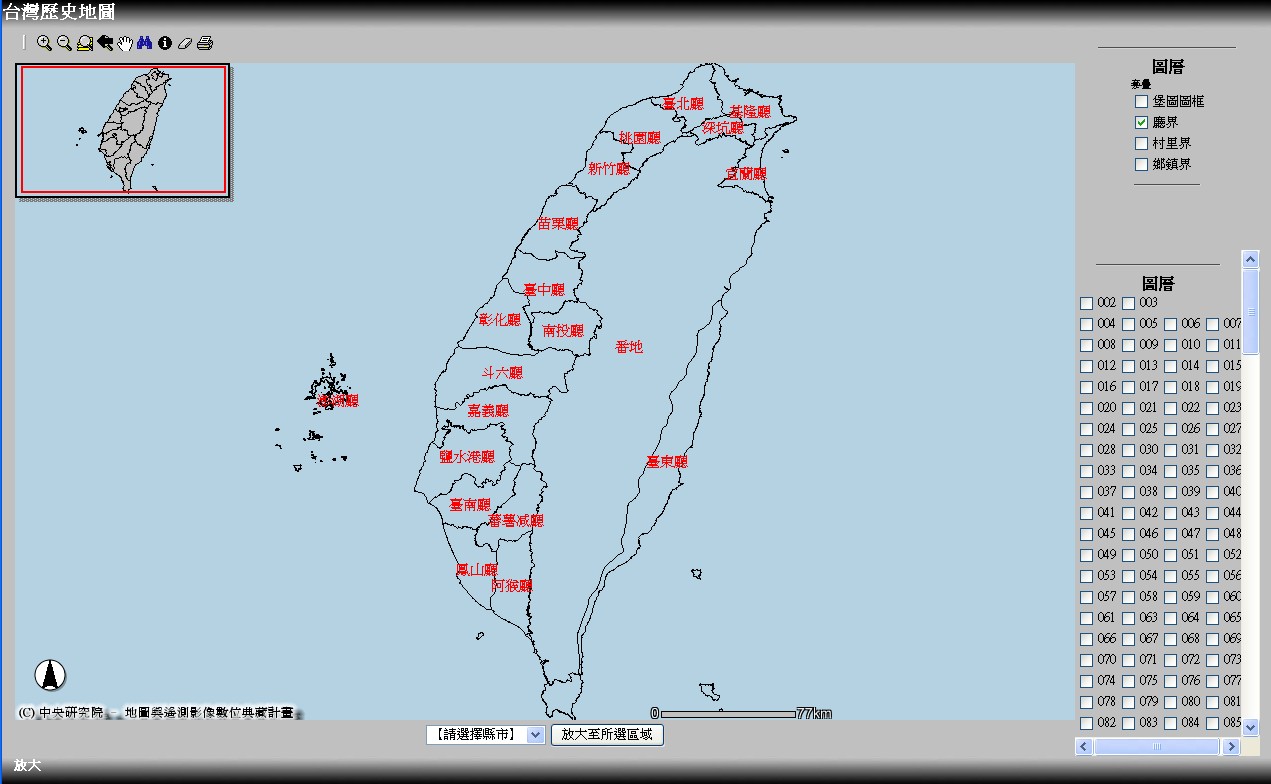 This website provides a list of historical place names in Taiwan. It also allows users to overlap maps with the frames of Taiwan Bau-tu and various administrative boundaries such as Ting, village, subward, county and town.
http://webgis.sinica.edu.tw/website/htwn/viewer.htm
0
Taiwan Provincial Consultative Council Digital Archives Program
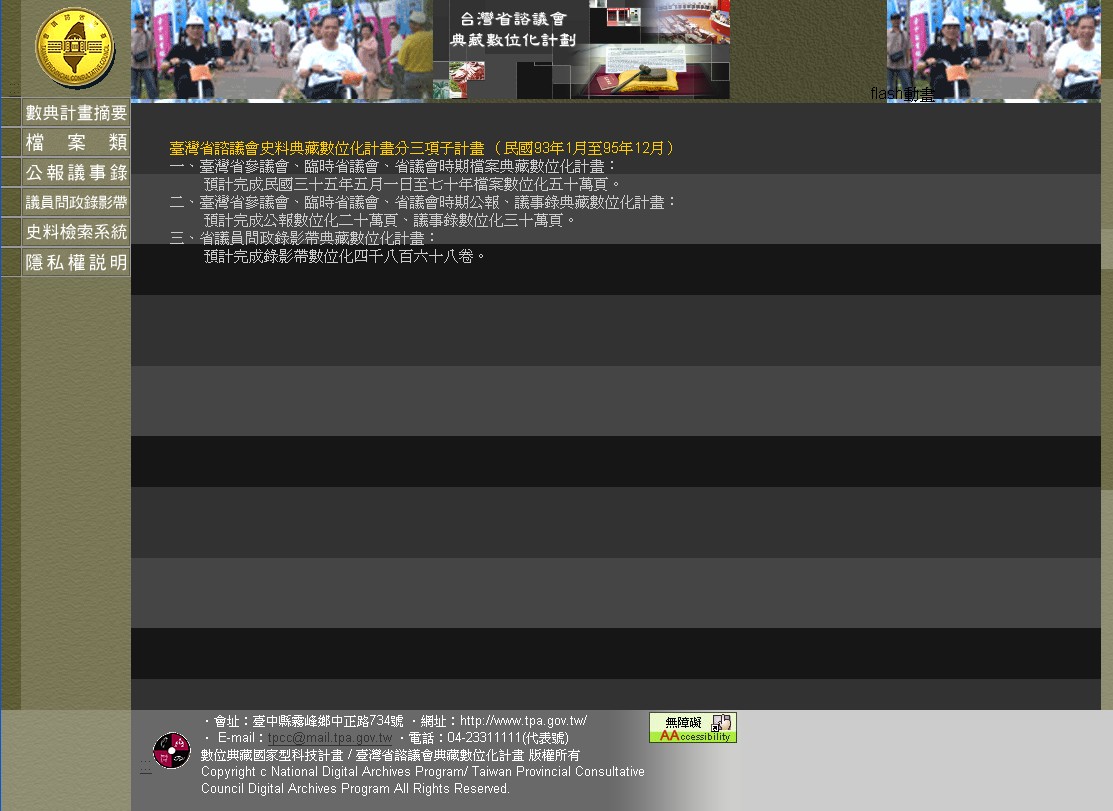 The objective of the Project is to build a digital archive of the historical documents preserved in the Taiwan Provincial Consultative Council, including Taiwan Provincial Government Recorders and the Bulletins and Transactions of the provincial legislative assembly during Taiwan Provincial Legislature, Taiwan Provincial Interim Assembly and Taiwan Provincial Assembly periods, and the historical documents preserved in the Institute of Taiwan History, Academia Sinica, including private documents, local government recorders and historical materials on Taiwan Study. The reason for choosing these historical documents as the subjects of the program is that these documents not only are vital to the study of Taiwan History but also record important events in the history of democracy, specifically the history of Legislative Politics, of our nation.
The Program spans three years, with the primary focus on integrating the Provincial Government Recorders and the Bulletins and Transactions of the provincial legislative assembly, the Addresses of the Legislatives and recordings during Sessions through Digitizing. Another focus of the project is on the integration of public and private documents, local historical materials, and historical Taiwan Study materials through the digitizing process and laying down the foundation of a databank of Taiwan History. Based on these objectives, the development of an index system, the Cataloging of the documents, the Authentication control of post-processing data and the integration of information is vital to the success of the Project.
With the successful implementation of the Project, not only historical materials can be preserved forever and utilized in all the variety ways but also historical materials on Legislative Politics are made available digitally for the first time. And the achievement of the Project also provides a framework for the digital preservation of legislation documents of all the under-level legislations and the development of related software packages.
0
The Digital Archives of Formosan Aborigines
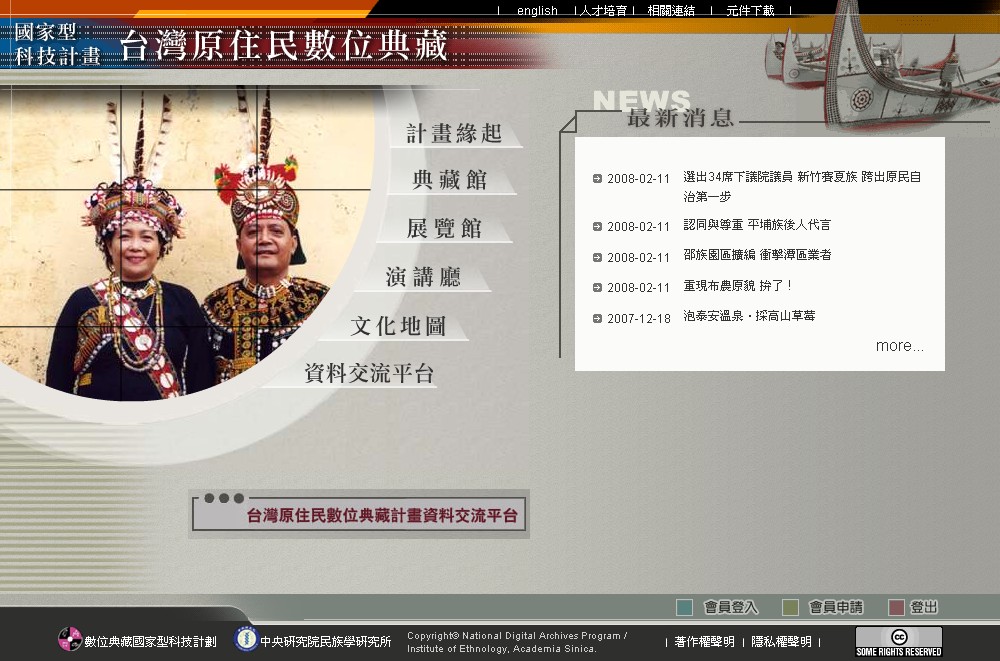 This website is a result of the “Digital Archives of Formosan Aborigines” under the “National Digital Archives Program” planned by the Academia Sinica. The “Digital Archives of Formosan Aborigines” is based on the Formosan Aboriginal cultural relics, literature, and audio-video information archived by the Museum, Library, and researchers of the Institute of Ethnology, Academia Sinica. The various kinds of information are digitalized and archived. Databases and search mechanism are constructed to provide researchers, educators and the general public the convenience when researching, teaching and exchanging information. Through this website, we hope to promote mutual understanding and respect among different cultural groups. We also hope to achieve the exchange and preservation of different cultures.
0
Taiwan Archives Online
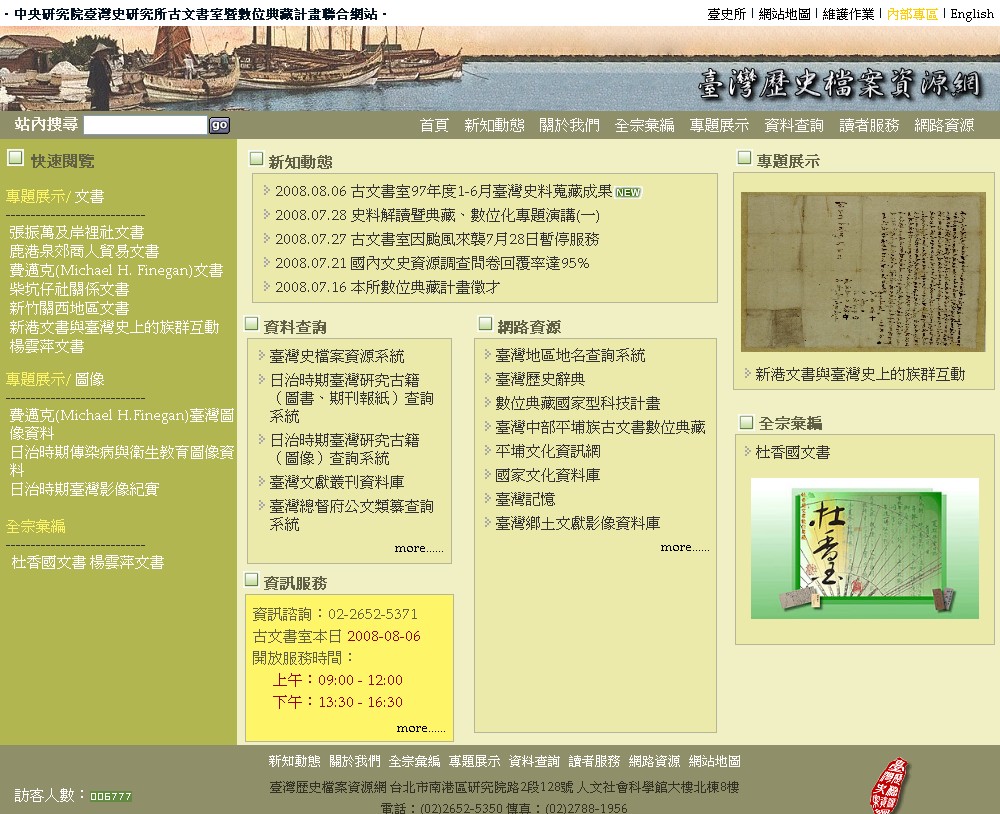 The main purpose of this project is to digitalize and preserve the rare and unique historic heritage of Taiwan. These primary source historic materials, currently held by Taiwan Provincial Consultative Council and Taiwan History Institute, Academia Sinica, include documents, archives, gazettes of Taiwan Provincial Senate, Temporary Provincial Assembly, and Taiwan Provincial Assembly as well as personal manuscripts and documents, local historic documents before 1945, and rare books of colonial period.
The output of this project in 2004 included:
1. Scanned Image: 235,000 images
2. Digitalized Video Film: 1,234 reels
3. Catalog: 31,500 items
4. Metadata Analysis: Finished
(1) archives, gazettes of Taiwan Provincial Senate, Temporary Provincial Assembly, and Taiwan Provincial Assembly;
(2) rare books of colonial period—books
(3) personal manuscripts of Prof. Yang Yun-ping.
5. On-line Catalog/Metadata Input System: Completed
(1) gazettes catalog input system;
(2) rare books of colonial period--books metadata input system;
(3) rare books of colonial period--periodicals metadata input system.
6. Metadata: 23,545 items
7. On-line System: Completed Scanning and Proofreading Administrative System for Digital Images
8. Database and Web Page: Completed and Testing
(1)database and webpage of rare books of colonial period—books;
(2)database and webpage of Prof. Yang Yun-ping.
0
Database of Native Plants in Taiwan
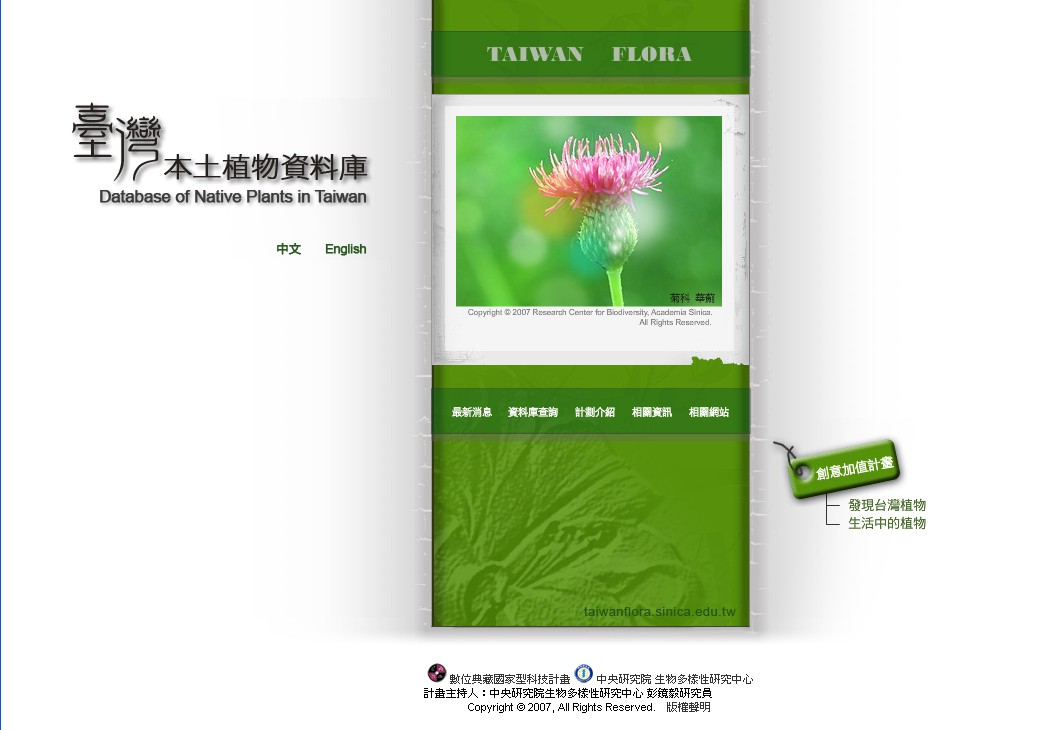 NDAP( National Digital Archives Project): Indigenous Plants is a project about Taiwanese botanical database. It consists of 1) label information of Taiwanese plant specimens housed at HAST (Herbarium, Institute of Botany, Academia Sinica, Taipei); 2) images of wild plant and specimens; 3) GIS-based plant distribution maps and 4) and taxonomic literature. Through this system, curatorial management of HAST herbarium is also effectively executed. Invaluable images of herbarium specimens as well as plant photographs taken in the wild are preserved permanently. This database serves as an effective tool for understanding our indigenous flora and their distribution. It also provides a useful reference to the utilization and conservation of the plant resources of Taiwan.
http://taiwanflora.sinica.edu.tw/
0
FishBase
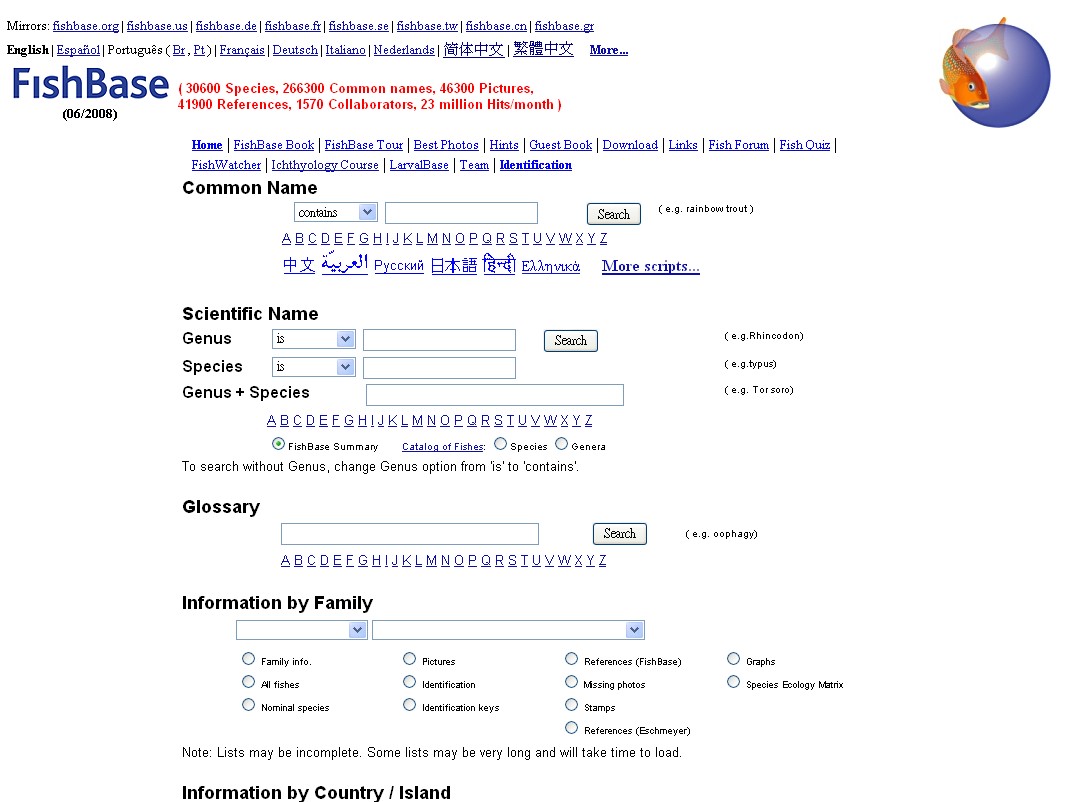 FishBase, a global information system with all you ever wanted to know about fishes. FishBase is a relational database with information to cater to different professionals such as research scientists, fisheries managers, zoologists and many more. FishBase on the web contains practically all fish species known to science. FishBase 2004 is also available on DVD or CD-ROMs with full information on 28,500 species. It comes together with the FishBase 2000 book and can be ordered for 95 US$ including air-mail.
FishBase was developed at the WorldFish Center in collaboration with the Food and Agriculture Organization of the United Nations (FAO) and many other partners, and with support from the European Commission (EC). Since 2001 FishBase is supported by a consortium of seven research institutions.
0
Diplomacy Archive Retrieval System
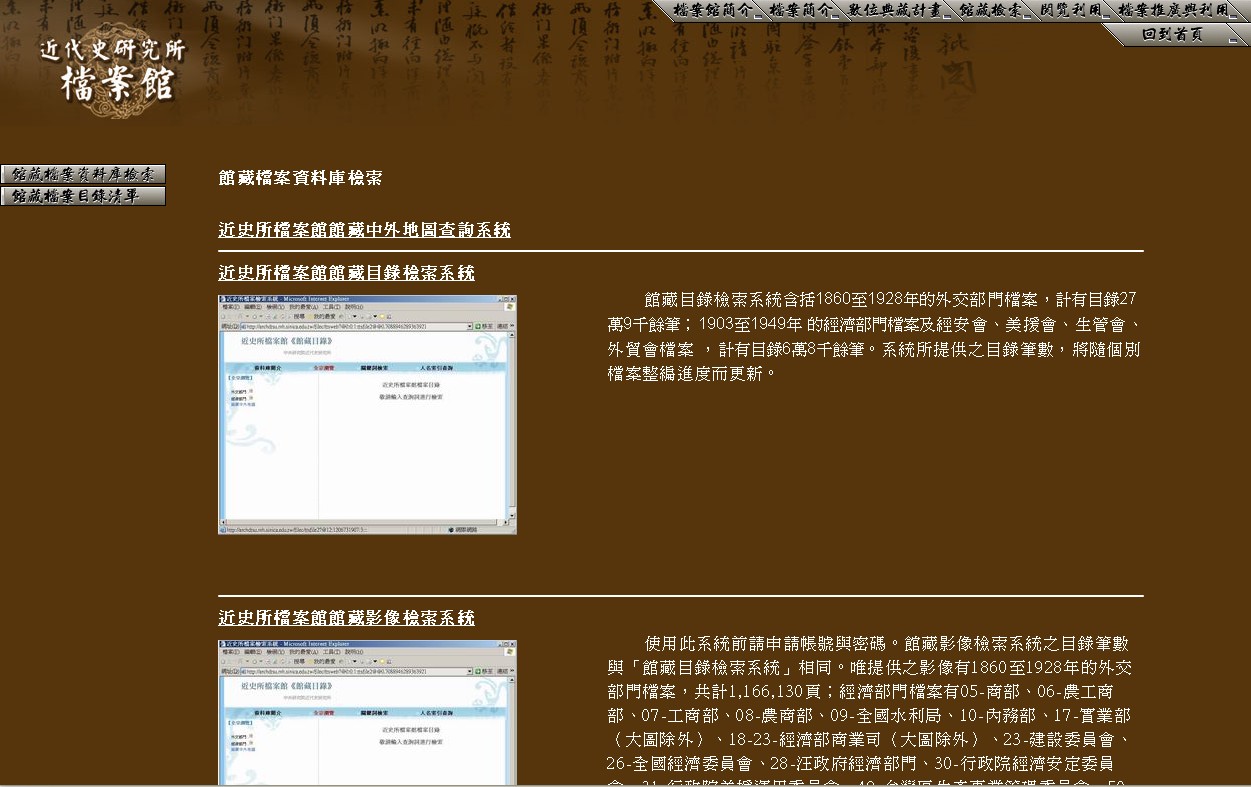 The National Science Council launched the National Digital Archives Program in 2001 to encourage Taiwan's archive institutes and collectors to digitalise their treasured collections of documents and artefacts which will then be used in added value application. The standards of relevant technologies would also be decided during the process of the Program. The digital archives of the diplomatic and economic records in modern history is a project of the Institute of Modern History, Academia Sinica, which is planning to complete the digital archives of diplomatic files and the documents of the International Economic Cooperation and Development Commission of the Executive Yuan in five years. We have finished in 2001 the digitalisation of the documents of the Ministry of Foreign Affairs, series 18-32, which consists of more than 40,000 entries of bibliographic records or about 290,000 pages of scanned images.
0
The Fish Database of Taiwan
 The fishes of Taiwan is comprised by 2,487 species in 252 families: about 10% of the world's fish. Taxonomic and distributional data of Taiwanese fish have been integrated into a database that can be accessed interactively over the Internet at http://fishdb.sinica.edu.tw. The database includes the following items: metadata on the fish and other animals or plants, basic information on species and families, curatorial (specimens) database which integrated 6 museums, distributional databases, a bibliographic database, underwater videos of fish, photo gallery of Taiwan fishes, rare Chinese characters with the “fish radical”, a search system for Chinese fish names of “Latin-Chinese Dictionary of fishes names”, and a new version of errata of “Fishes of Taiwan.” The result of this project has been made available for public access on the web. The “Fish Database of Taiwan” can be linked to the global fish database – “FishBase, http://www.fishbase.org” of WorldFish Center, and by using the species names as the primary key, more detailed information about each species can be obtained. This project also established a Chinese mirror site of FishBase ( http://fishbase.sinica.edu.tw) in Academia Sinica. Such collaboration between local and global database exemplifies local or regional biodiversity databases moving toward international cooperation.
0
Taiwanese Shellfish Database
 This project, Taiwanese Shellfish Digital Archives, is one of the projects of Taiwanese Fauna Archives under the National Digital Archives Program. Taiwan holds rich resources of shellfish, for the island is located in the Indo-Pacific Region where there are the widest distribution and variety of shellfish in the world. However, Taiwan's shellfish is declining rapidly in both quantity and variety because of the growing pressure of population, the advance of industrial activities, the continuing enlargement of pollution area, the destruction of habitat by earthquake and other natural disasters, etc. There is therefore a need to establish a Taiwanese shellfish digital database before it is too late.
This project will be based on the Taiwanese shellfish database established by the project director on the Academia Sinica website (http://shell.sinica.edu.tw) plus the results of the director's near 20 years’ work on shellfish such as her/his collection, journal articles and monographs, literature reviews and specimen collection. It is hoped that with this middle to long-term project we will establish digital archives of about 1,500 to 2,000 species of Taiwanese shellfish about which we already have sufficient knowledge. Information included in this digital archive will be classified into the following fields: English and Chinese scientific name, place of origin, distribution, physical feature, reference, shellfish vita (habitat, resource and similar information), source and features of specimen, specimen image, remark, etc. We believe that this digital archive is significant contribution to the teaching, research and promotion of Taiwan's indigenous species, resource management, and national land use and wildlife conservation not only for the time being but also for the future.
0
Digital Archives of the Diplomatic and Economic Records in Modern China
 The Institute of Modern History, Academia Sinica, has kept a collection of files on foreign and economic offices and data donated by individuals. The files on foreign offices include documents from the Office in Charge of Foreign Affairs (1861-1901), Ministry of External Affairs (1901-1911) and Ministry of Foreign Affairs of the Northern Government (1912-1928). The economic files contain related documents from various economic offices of the Republic of China including the Ministry of Commerce established in 1903 of the late Qing Dynasty until 1949, and various economic offices since Kuomintang Government retreated to Taiwan. Individually donated data cover areas in politics, economics, academics and culture. These are all historical material essential to the study of historic development of modern China and Taiwan after WWII. In addition to selection of important files for digital replication, building of file indexes and a database for image search to provide online access to authorized readers, this project will also continue to help the installation of a website focused on the modern diplomatic history of China, provide relevant information for platform integration, and promote the education and study of modern diplomatic history.
0
Academia Sinica Tagged Corpus of Early Mandarin Chinese
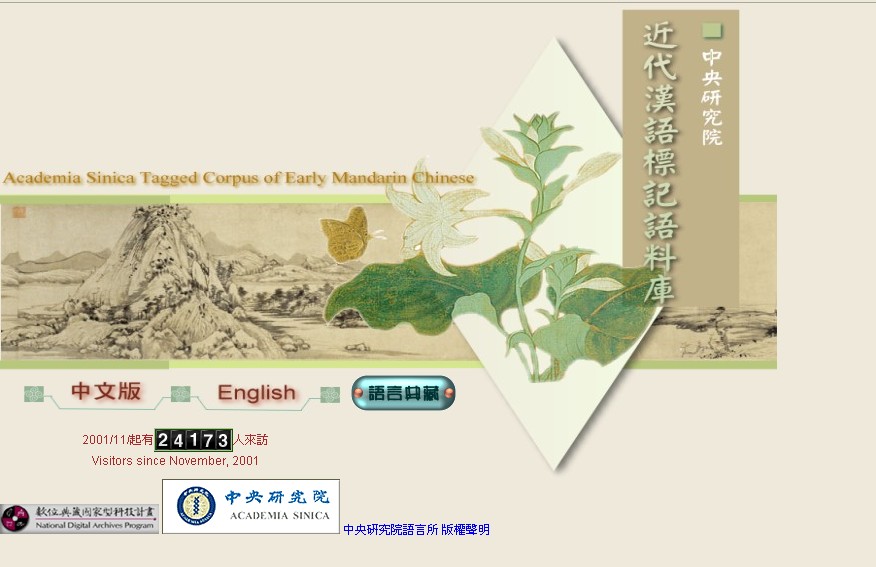 "Early Mandarin Chinese Lexicon" is designed as part of the Lexical Knowledgebase (LKB). The goal of LKB is to trace the historical changes of the Chinese language, and will contain a series of synchronic lexica from Pre-Qing to Modern Mandarin. This project archived materials that include written records of lectures, documents of laws and decrees, and fiction and drama of the Ming-Qing period.
http://www.sinica.edu.tw/Early_Mandarin/index.html
0
Technology Development for Digital Archives
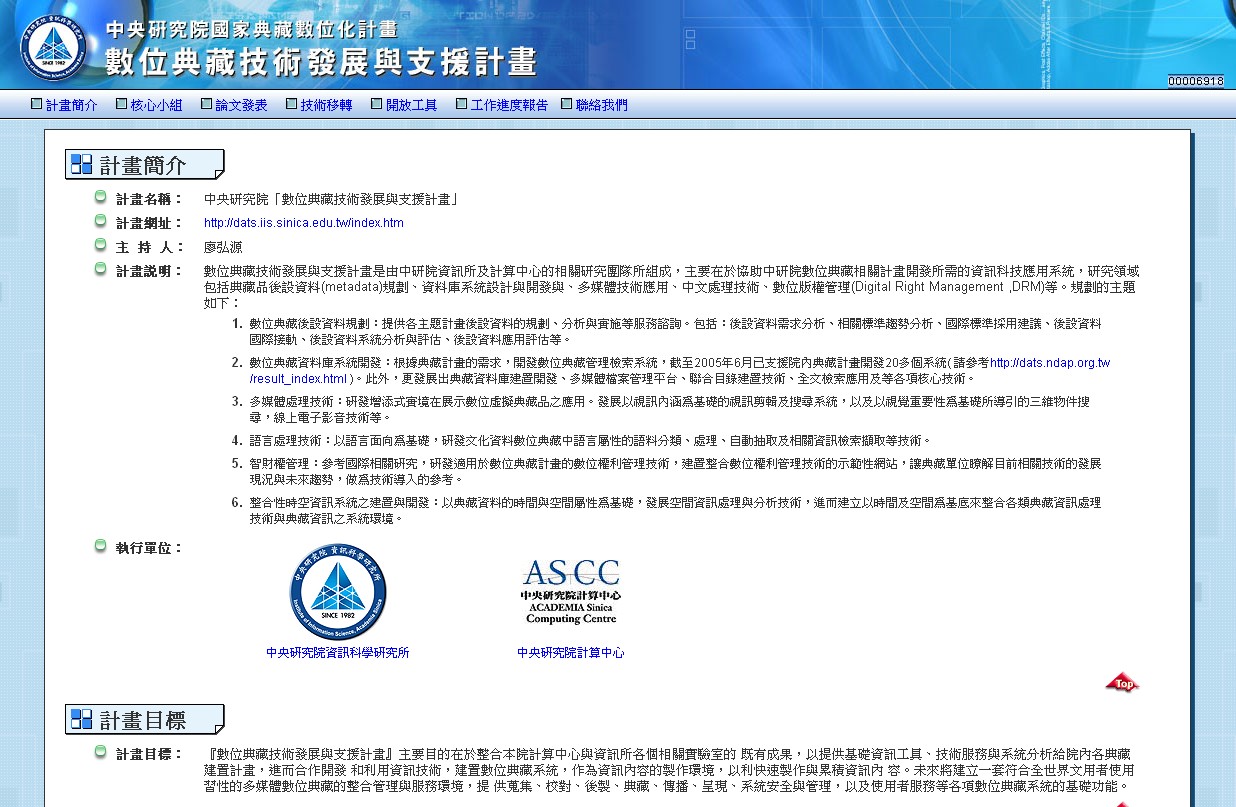 Technology Development for Digital Archives Project is executed by teams from the Institute of Information Science and the Computing Centre, Academia Sinica. Its main function is to help project teams of digital archives in Academia Sinica with the development of required information technology application system, especially in the following fields: digital archive metadata, database system, application of multimedia, Chinese language processing technique, digital right management or DRM. The tasks of this project are therefore as follows: design of digital archive metadata, development of digital archive database, development of digital archive management and retrieval system for digital archive projects, multimedia processing technique, language processing technique, intellectual property rights and the establishment and development of integrated spatial and temporal information system.
0
Sinica Treebank Version 3.0
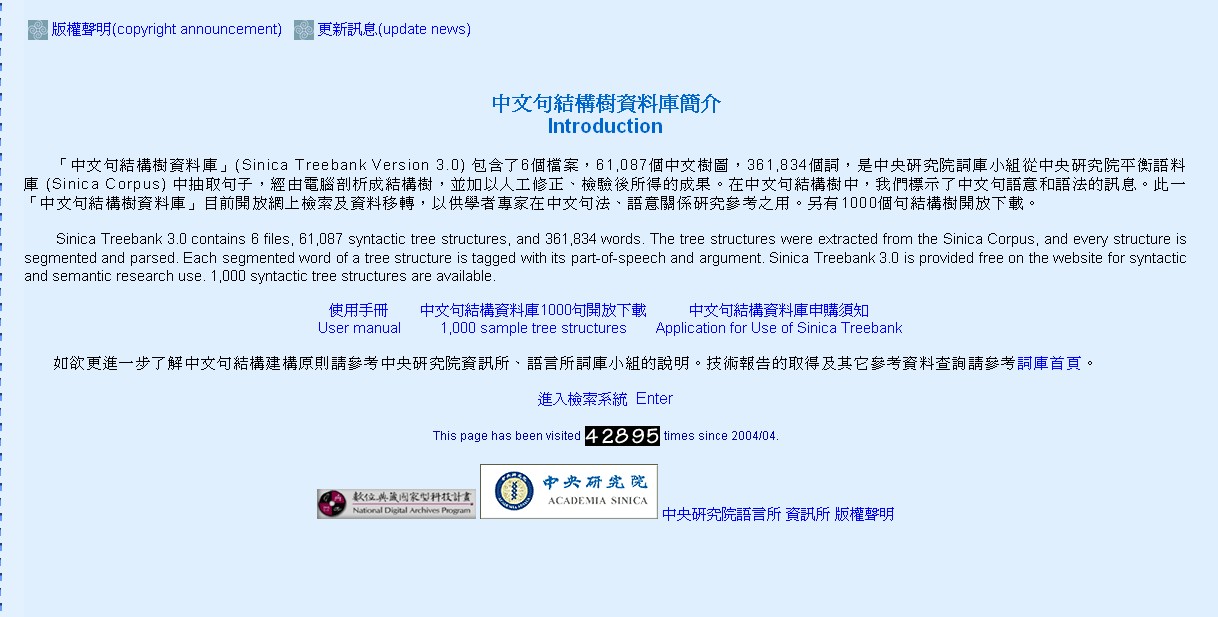
Sinica Treebank 3.0 contains 6 files, 61,087 syntactic tree structures, and 361,834 words. The tree structures were extracted from the Sinica Corpus, and every structure is segmented and parsed. Each segmented word of a tree structure is tagged with its part-of-speech and argument. Sinica Treebank 3.0 is provided free on the website for syntactic and semantic research use. 1,000 syntactic tree structures are available.
http://turing.iis.sinica.edu.tw/treesearch/
0
Academia Sinica Balanced Corpus of Modern Chinese
 "Academia Sinica Balanced Corpus of Modern Chinese", simplified as Sinica Corpus, is designed for analyzing modern Chinese. Every text in the corpus is segmented and each segmented word is tagged with its part-of-speech. Texts are collected from different areas and classified according to five criteria: genre, style, mode, topic, and source. Therefore, this corpus is a representative sample of modern Chinese language.
http://www.sinica.edu.tw/SinicaCorpus/
0
Archives and Linguistic Representations of Spoken Taiwan Mandarin
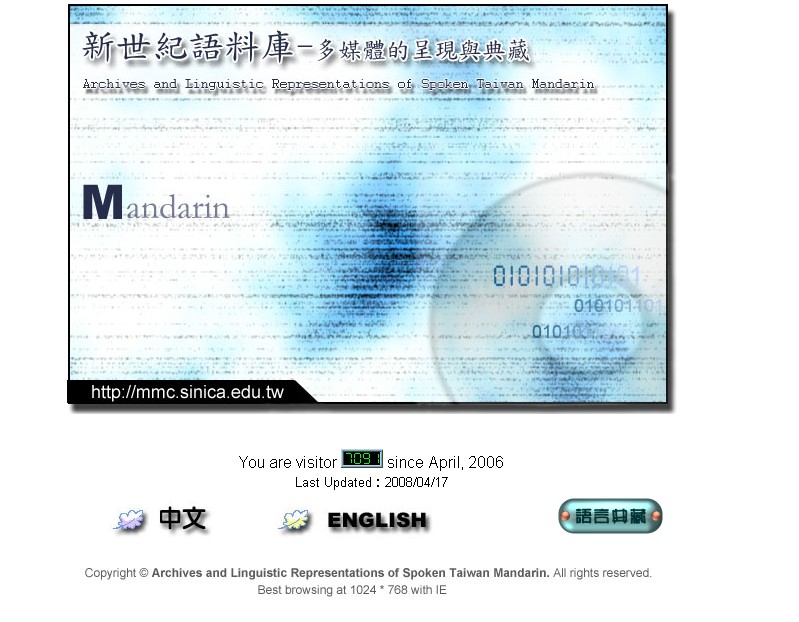 The "Mandarin spoken corpora project" is part of the Language Archives Project (National Digital Archive Project). The main aim of the "Mandarin spoken corpora project" is to collect a wide variety of speech data of Taiwan Mandarin and to digitally archive the use of Taiwan Mandarin in audio and video data formats. The project consists of (1) speech data collection and processing, (2) toolkit and database development, (3) metadata management, (4) speech annotation design and (5) web query system construction. Three main Mandarin spoken corpora are currently in working, funded by the Institute of Linguistics, National Science Council and the National Digital Archives Project.
These include "Mandarin Topic-oriented Conversation Corpus" (MTCC), "Mandarin Conversational Dialogue Corpus" (MCDC) and "Mandarin Map Task Corpus" (MMTC). The annotation systems include "discourse annotation", "detailed spontaneous speech phenomena" and "particular phonetic phenomena". Web users can also use our web query system to search for keywords and annotations marked in the corpora mentioned above.
0
Academia Sinica Formosan Language Archive
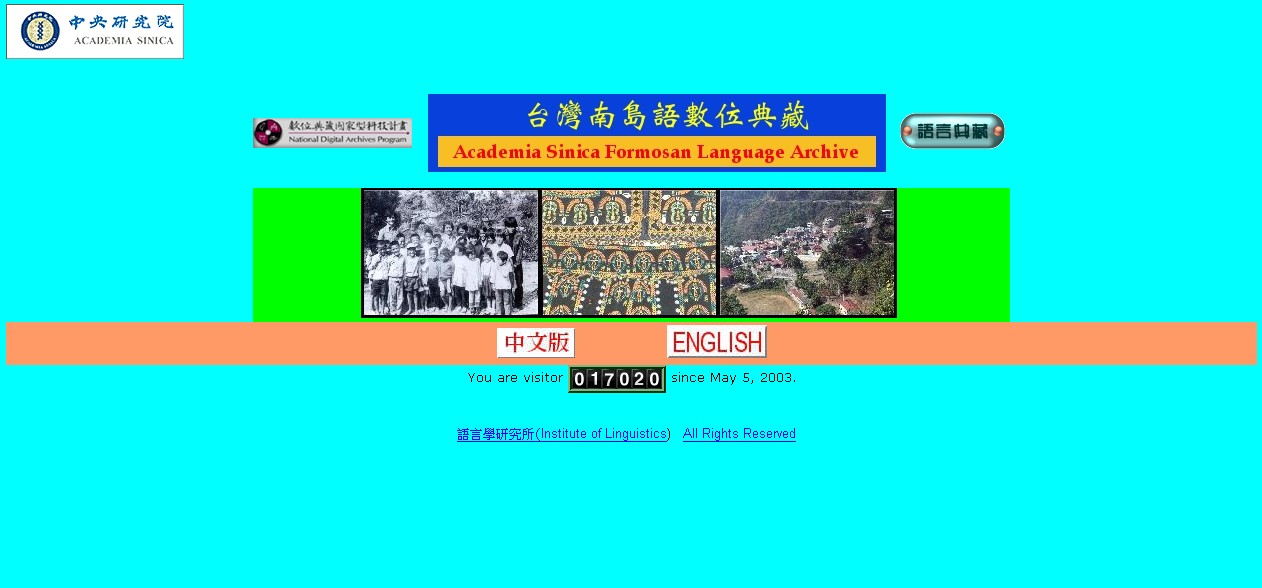 The Formosan Language Digital Archive is part of the Language Digital Archive developed within the Academia Sinica under the auspices of the National Science Council. The conceptaul design of the Formosan Language Archive has been made under the direction of Elizabeth Zeitoun. The aims of this project are to collect, conserve, edit and disseminate via the world wide web a virtual library of language and linguistic resources permitting access to recorded and transcribed Formosan data collections.
0
Language Archive of Digital Archives
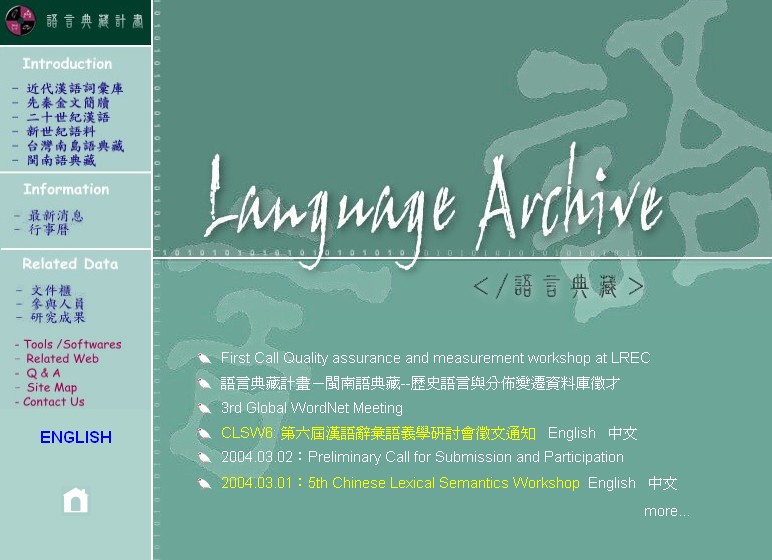 The project has two branch projects on Chinese and Formosan Language archives. The former is further divided into 5 sub-projects. The latter aims to preserve the endangered Formosan Austronesian languages with corpora, lexicons and grammars of each language. Its innovations include integration of linguistic information with GIS. Among the Chinese archives, 'Early- Mandarin Chinese Lexicon' is designed to construct a knowledge system of Chinese language evolution from the early modern to the modern era. 'Lexical Database of Pre-Qin Bronze and Bamboo Manuscripts' aims to build a lexicon of Yin, Zhou, and ChunQiu bronze inscriptions, and the bamboo manuscripts of the Warring States. Its goal is to give an overview of Chinese phrases from the Pre-Qin era through the Han dynasty. 'Modern Chinese Corpus and Treebank' puts emphasis on structurally annotated archives for value-added applications such as IR, automatic QA, and summarization. 'Archives and Linguistic Representation of Spoken Taiwan Mandarin' documents the everyday usage of modern Chinese in Taiwan in digital multimedia forms. 'Southern-Min Archive: A Database of Historical Change in Language Distribution' is a new addition in 2003. It aims to provide both a historical depth and sociological complexity to the archives of native Chinese languages in Taiwan.
0
Southern Min Archives: A Database of Historical Change and Language Distribution
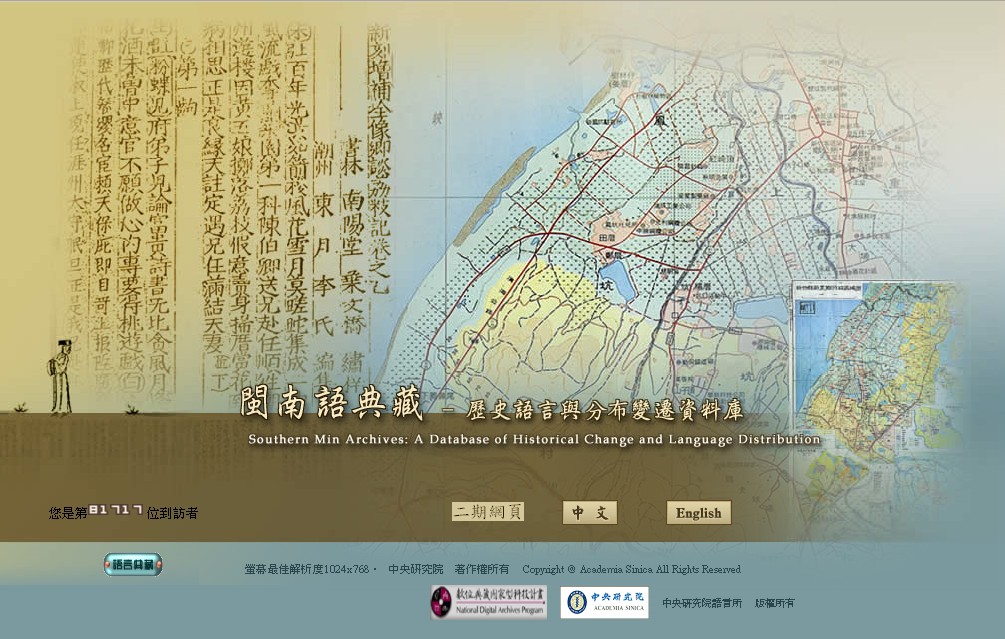 The "Southern-Min Archive: A Database of Historical Change in Language Distribution" project is a new addition in 2003. It aims to provide both a historical depth and sociological variation to the archives of Chinese languages in Taiwan.
http://southernmin.sinica.edu.tw/
0
Database of Minority Peoples in Southwestern China
 Ethnological Images Database Project is one of the digital archive projects in response to the call for preserving photos of minority peoples collected during field research by the Institute of History and Philology. These photos are precious information about the peoples’ daily life, their villages and forts, religious rituals, physical features, etc. This project will design a digital archive database for preservation, research and educational promotion of these photos as well as a tailor-made information management system that arranges ethnological images and photos by date and subject. These invaluable photos will thus be preserved in a perfect condition.
A major part of these ethnological photos were collected by the Institute during 1929 to 1943 when its research teams were dispatched into the southern, southwestern and northeastern areas of China for long-term and intensive field research. A vast number of artefacts, documents and field photos were taken and preserved in this task. The Institutes’ researchers again collected some other artefacts, photos and audio data of these minority peoples in their field research in southwestern China after 1990s. These new materials are very important for the history and cultural study of minority peoples in contemporary China, for we can understand the cultural and social development of peoples in that area through comparison of these new data with the old ones.
0
Oracle Bone Script Digital Archive
 Since 2004, this project has established a digital archive of the Institute's collection of more than 40,000 oracle bone rubbings acquired either from excavation or by purchase. Our archive includes illustrated articles and data, so that users not only can retrieve basic data and articles of oracle bone rubbings, but also compare words with pictures. Besides, users could find more detailed information, images and photos of real rubbings by clicking on display items’ archive numbers on the ‘Real Object’ web page which link to the website of Archaeological Digital Archives. As to the problem of missing character on web pages, the Institute of Information Science, Academia Sinica, has already accumulated enough experience of the digitalisation of archaic Chinese scripts and characters in its design of Chinese Character Construction Database that includes ancient scripts such as the regular script, small seal script , bronze script and Chu scripts. Therefore, this project office will solve the problem of missing characters of the oracle bone script by cooperating with the Institute of Information Science in building Oracle Bone Script Construction Database.
0
Encyclopaedia of Archaeology
 This website is an archaeological website designed for children by introducing archaeological knowledge with games and in plain language.
http://archeodata.sinica.edu.tw/h7/index.html
0
Archaeological Digital Archive
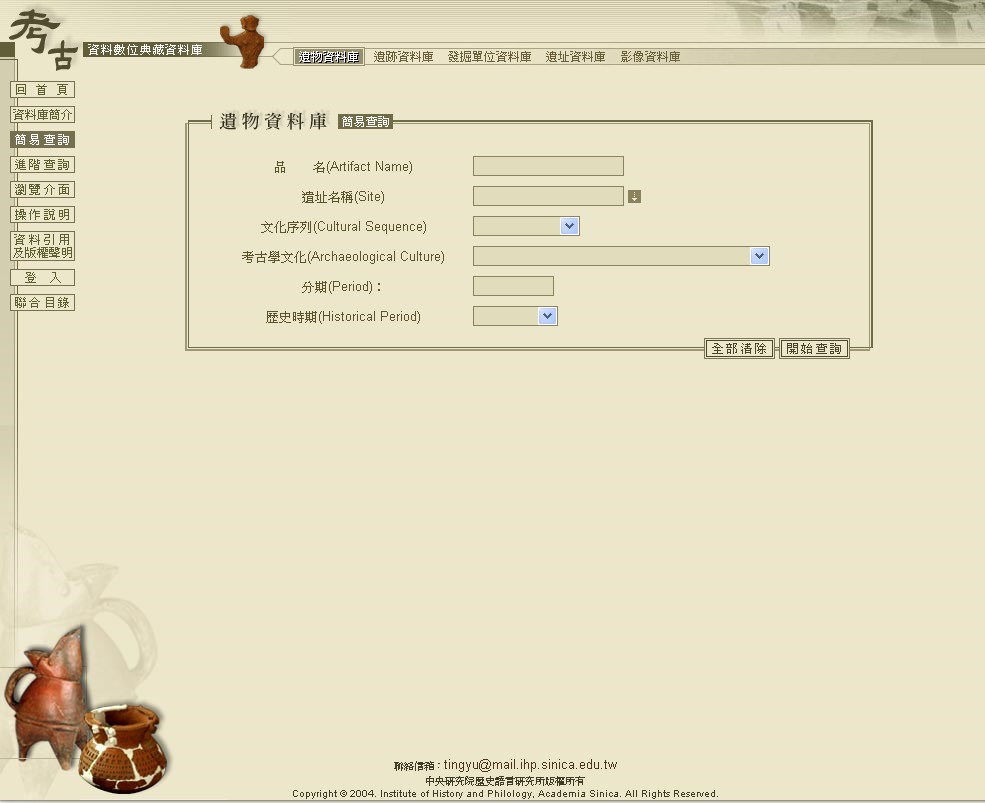 Archaeological Digital Archive is a database based on the outcome of archaeological research by the Institute of History and Philology, Academia Sinica. The part of archive that is open for public use currently is the Institute's published works and archaeological reports. Our database has the following two features. First, it divides into the three sections of site, feature and artefact according to archaeological genealogy. The other feature is its various multimedia resources such as archaeological photos, line graphs, rubbings, field research forms, burial lists, maps which are digitalised and stored in the multimedia section as video, sound, documentary, etc.
http://ndweb.iis.sinica.edu.tw/archaeo2_public/System/Artifact/Frame_Search.htm
0
Buddhist Stone Statute Rubbings—Middle Age Map Search
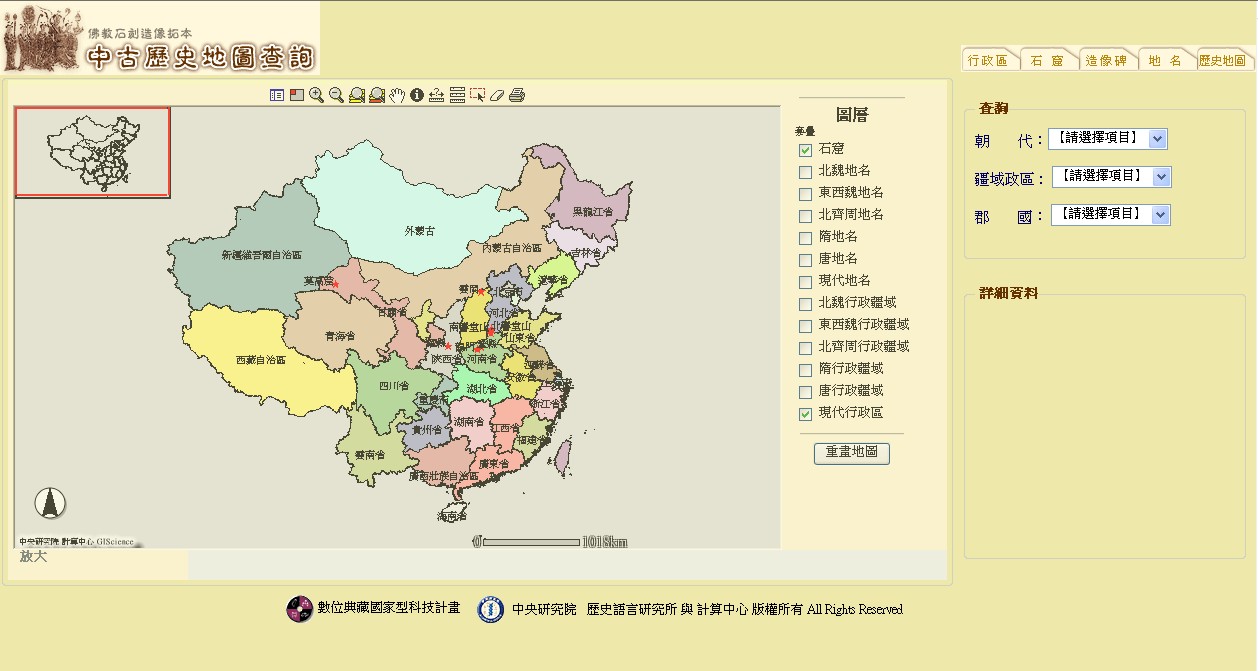 This website contains different kinds of maps: Buddhist cave maps, historical maps from the Northern Wei to Tang Dynasty and administrative maps of modern China. The website therefore offers two services: one is the retrieval service of image steles, place names and historical maps; the other is the geographical and historical information of Buddhist caves in reference to administrative maps of modern China.
http://webgis.sinica.edu.tw/website/Buddhism/
0
Buddhist Stone Statute Rubbings
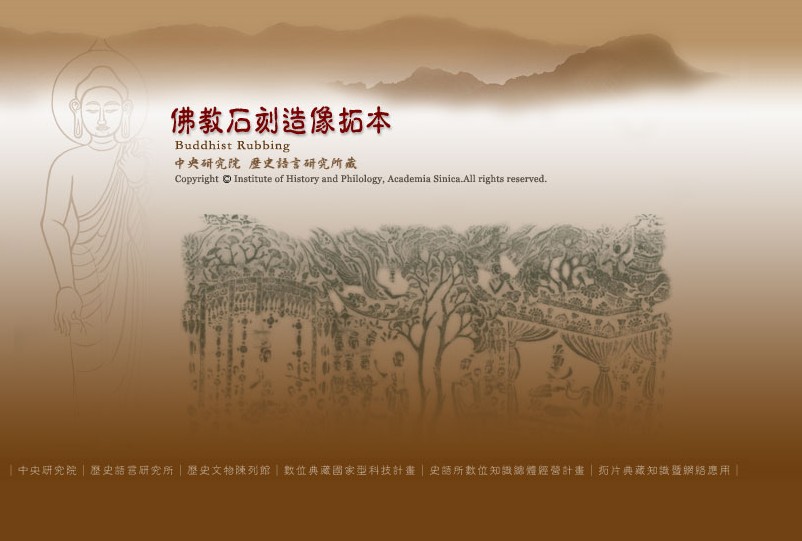 Buddhist stone statute rubbings database includes minor rubbings of Yao county image steles, Bao Shan cave and other image steles whose original statutes had been destroyed, in addition to its collection of well-known rubbings from Yungan cave of the northern Wei, Longmen cave, Fang Shan Cave, etc. The remarks on rubbings are important materials for the study of middle age China, for they are not only the preambles of statue makers, but also accounts of statues, motivation of statue making, the organisation of Buddhist communities in religious rituals, etc., and more importantly, they also tell us the scale of temple buildings, land donation contracts, and relationship between monks, nuns and secular people.
0
Village and Fort Website—the Minority Peoples in Southwestern China
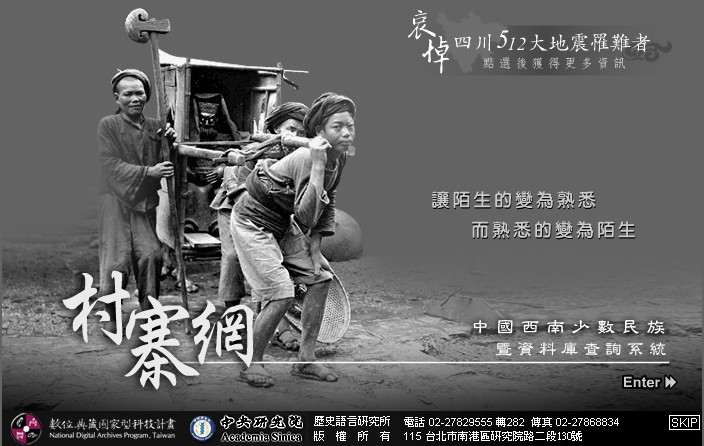 This website is part of the National Digital Archives Program. Our team, participating in the project of treasured historical artefacts under the Institute of History and Philology, Academia Sinica, is in charge of ethnological materials such as images, documents and artefacts collected by the Institute's research fellows. These materials are digitalised and arranged in three categories: image, document and artefact. They will be put on website and database for research and promotion purposes. In addition, it is hoped that this project will also serve as a bridge between current and previous studies of minority peoples in southwestern China. This website therefore includes a section of China's Peripheries Reconstructed which recalls the dispatch of many researchers by the Institute to collect ethnographic data in the remote areas of southwestern China more than 60 years ago. This section also introduces the academic background of those researchers.
0
Retrieval System of Personal Name Authority File of the Ming and Ch'ing Archives
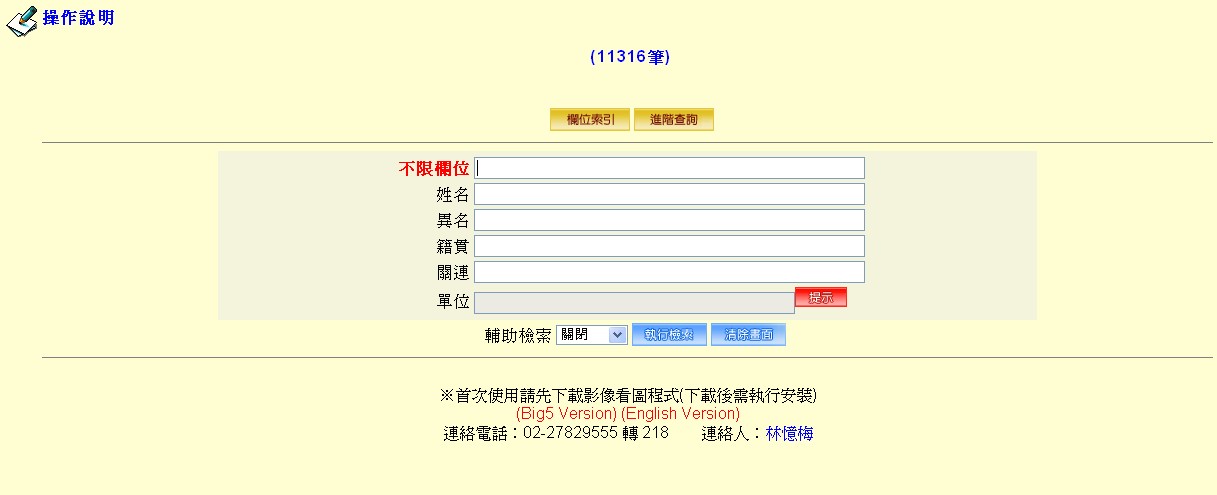 This website provides retrieval service of personal name authority files of the Ming and Ch'ing archives. There are two types of search. Simple search provide unspecified retrieval of information disregard its fields such as personal names, alternative name, hometown, relationship and unit while advanced search provides Boolean logic-based retrieval.
http://archive.ihp.sinica.edu.tw/ttscgi/v2/ttsweb?@0:0:1:mctauac@@0.5660214255227534
0
Database of Personal Name Authority Files of the Ming and Ch'ing Archives
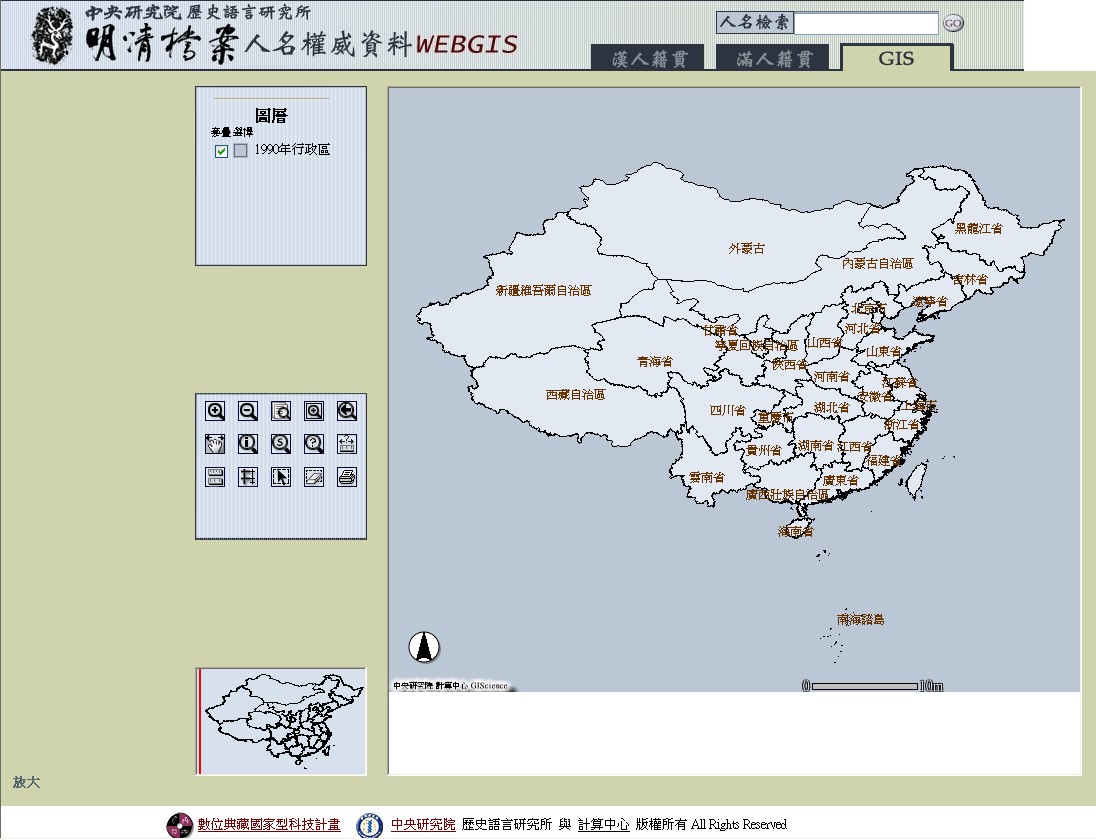 This website displays personal name authority files of the Ming and Ch'ing dynasties on GIS maps. It serves as a personal name retrieval system that allows users to browse Manchurian hometowns, Han hometowns and GIS maps.
http://webgis.sinica.edu.tw/website/people/viewer.asp
0
Retrieval System of Han Dynasty Wooden Slips from Edsengol
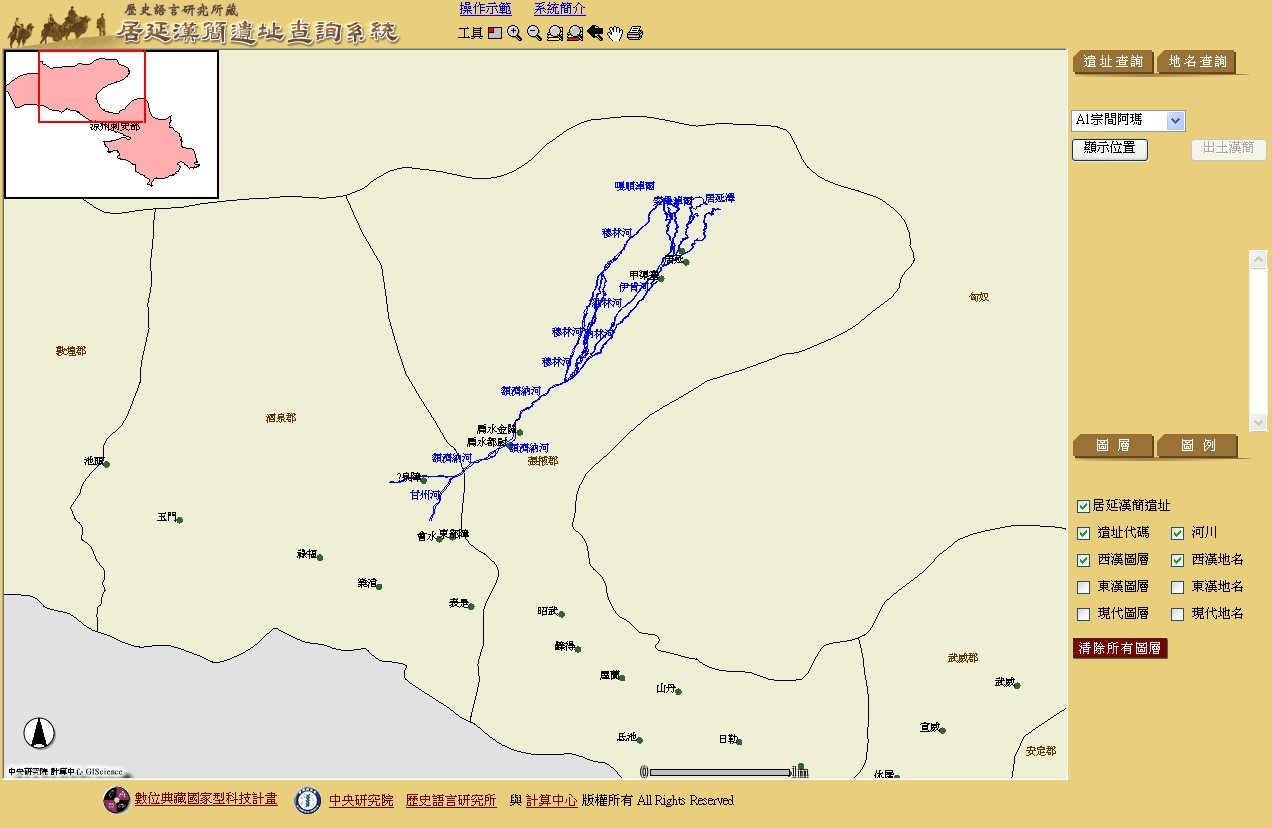 This system which is a product of cooperation by the Institute of History and Philology and the Computing Centre, Academia Sinica, works as a search tool for historical sites in Edsen-gol where the Institute's Han Dynasty wooden slips were excavated. Users can compare the spatial and temporal information on the historical maps of Liang Chou Cishibu of the two Han Dynasties with the maps of modern China by overlapping maps. This website also uses maps and menus as links to the other database of Han wooden slip digital archive (http://140.109.18.243/woodslip_public/System/Main.htm) for further information of excavation sites and excavated Han wooden slips.
0
Grand Secretariat Archives Project
 The “Grand Grand Secretariat Archives refers to the documents originally located in the storerooms of the Grand Secretariat of the Qing dynasty. These documents were originally sold to the paper factory but fortunately recovered and later passed on to the Institute of History and Phllology through several changes of hands in the early Republican era. The total number of documents in our collection is estimated at 310,000 items. The collection, dating from the Ming dynasty to the late Qing dynasty, encompasses a great variety of subjects. Serious researchers of Ming-Qing studies should not miss the opportunity to explore this wonderful collection. Please refer to the “Grand Secretariat Archives-Inventory and History of Preservation” for more detailed information regarding its contents, how it came into our possession, as well as the efforts that have been devoted to its preservation and inventory.
The Grand Secretariat Archives Project was launched in 1981. Much of its early work focused largely on conservation and cataloging. Since 1996, the digitization and metadata management of these materials has also been underway. More detailed metadata has been supplemented to each document in order to provide file description and searchable key words. The documents were also scanned, photographed, and stored digitally using the latest technology. Since this is an ongoing project, the database is updated constantly. The database has been opened to serve public interest since March 2001. Researchers, students, and the general public may browse through the table of contents free of charge, or search the complete database after registration.
0
Bronze Rubbings Digital Archive
 Fu Ssu-Nien Library of the Institute of History and Philology holds more than 10,000 bronze rubbings (bronze script rubbings) which are the treasured collections of the famous connoisseurs Liu Li-zh and Chen Jie-chi from the late Ch'ing to the early Republic of China. Many of these rubbings were made by the renown artisans Chou Kang-yuan and Wang Siou-ren themselves. These beautifully made and carefully sealed rubbings, not only preserving the scripts, decorative patterns and shapes of many bronze artefacts, but also recording the remarks and seals of many past collectors and reviewers, are great works of art. In order to improve both the public access to these precious rubbings and their preservation condition, the Institute has worked hard on their digitalisation for public use on line. In 2004 the Institute officially announced its Bronze Rubbings Digital Archives at a conference on bronze and stone rubbings digital archives.
0
Treasured Historical Artefacts Digital Archives
 This project includes the following five sub-projects. 1.digital archives of archaeological data. 2.rubbings and archaic texts. 3. rare books of Fu Ssu-Nien Library. 4. Ethnological Specimens, photos and archives and 5. the Grand Secretariat archives. According to our investigation, the major collection of the Institute of History and Philology includes about 1,200,000 Taiwanese artefacts, 140,000 Chinese archaeological artefacts, 2,000 ethnological specimens and documents, more than 8,000 photos of field research, about 200,000 volumes of rare and antique books including folk literature, more than 310,000 items of the Ming and Ching archives, about 40,000 bronze and stone rubbings and more than 11,000 Han wooden slips.
The first stage of this project, Treasured Historical Artefacts Digital Archives based on the general goals and execution principles of the National Digital Archives Program, was one of the institutional projects under Academia Sinica and was in charge of the digitalisation of the treasured artefacts in the Institute of History and Philology. The Institute's artefacts are divided into the following main categories: archaeological materials (oracle bones, bronzes, jade, stone objects and pottery), bronze rubbings, oracle bone rubbings, tomb inscriptions of different dynasties, stele rubbings, Han stone carving rubbings, Buddhist stone carving rubbings, seals, pottery scripts, rare and antique books, the Ming and Ching archives, and the Han wooden slips from Edsengol. These various and precious collections of the Institute is due to the admirable effort of its founding director, Mr. Fu SSu-Nien and a group of young and outstanding scholars under his leadership who brought these invaluable treasures to the Institute through excavation, purchase, rescue of artefacts from human or natural destruction, field research and in every other possible way. They were said to hunt high and low, scouring cultural materials by dirtying their hands and feet. Many of these collected artefacts are valued as world-class cultural heritage of all human beings. Archaeological artefacts are scientific historical materials because they are products of field research through the rigorous procedure of which the date, location and other details of every artefact are recorded methodically. The importance of excavated objects in academic research is beyond doubt.
0
Rubbings Data
 The collection of the Institute of History and Philology contains approximately 40,000 rubbings acquired since the beginning of its establishment in 1928. The collection consists of rubbings of oracle bones (excavated in Anyang, Henan province), bronze, tombstone stelae, brick reliefs, Buddhist stone sculptures and inscriptions, pottery and seals. Most were purchased or donated to the Institute, or made by specialists of the institute. The collection also includes the Han wooden slips, excavated at Edsen-Gol, Inner Mongolia, and dozens of Han-Chin slips from the Lop-nor area.
Results of this project are as follows:
1. Bronze Rubbing
(1).Database of Bronze Image Rubbings collected in the Institute of History and Philology.
(2).Database of Bronze Inscription Rubbings collected in the Institute of History and Philology.
2. Buddhist Rubbing Database of Buddhist Rubbing collected in the Institute of History and Philology.
3. Han Dynasty Wooden Slips Database of the Han Wooden Slips collected in the Institute of History and Philology.
4. Rubbings of Han Dynasty Stone Relief Database of Rubbings of Han Dynasty Stone Relief collected in the Institute of History and Philology (still under construction).
5. Oracle Rubbing Database of Oracle Rubbings collected in the Institute of History and Philology (still under construction).
0
Bronze Scripts and Vessels of the Shang and Chou Dynasties
 Bronze Scripts and Vessels of the Shang and Chou Dynasties is an on-line digital database system developed by the Institute of History and Philology, Academia Sinica. The main source of this database is the Collected Works of Bronze Scripts in the Shang and Chou Dynasties. The main feature of this database is its powerful on-line information service about bronze script rubbings, commentaries, date, excavation site, etc. This database is open only to registered users. Users should read the terms of service before registration.
0
Historical Maps of the Chin and Han Dynasties
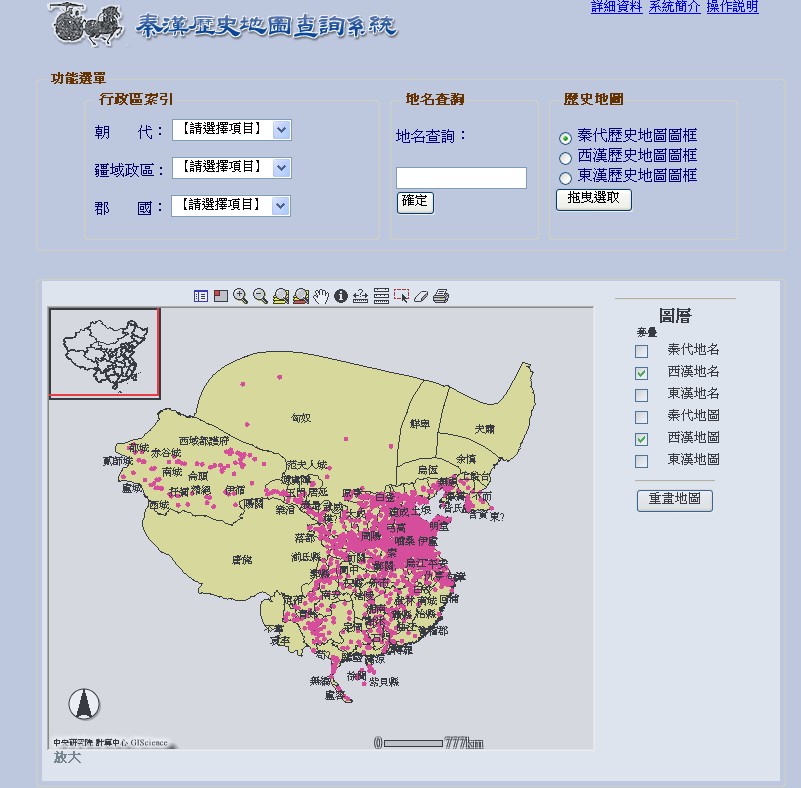 This website allows users to search not only the historical area of Liang Chou Cishibu but also other historical information about the Chin and Han dynasties such as their governing territories, administrative hierarchies, place names and history of institution.
http://webgis.sinica.edu.tw/website/qinhan/
0
Geospatial Information System of Fu SSu-Nein Library
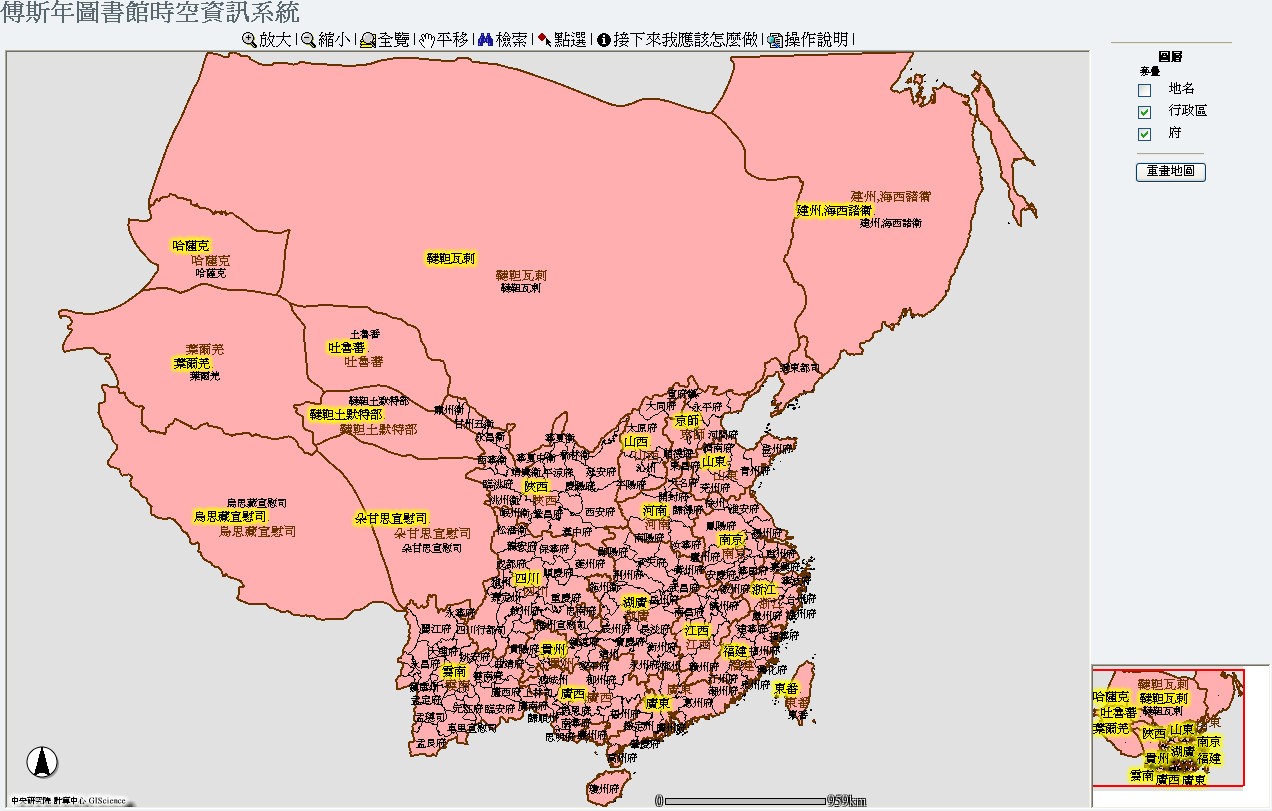 This website displays personal name authority files of Fu SSu-Nien Library on maps.
http://webgis.sinica.edu.tw/fsnac/viewer.htm
0
Site Inquiry System of Han Stone Relief Rubbings
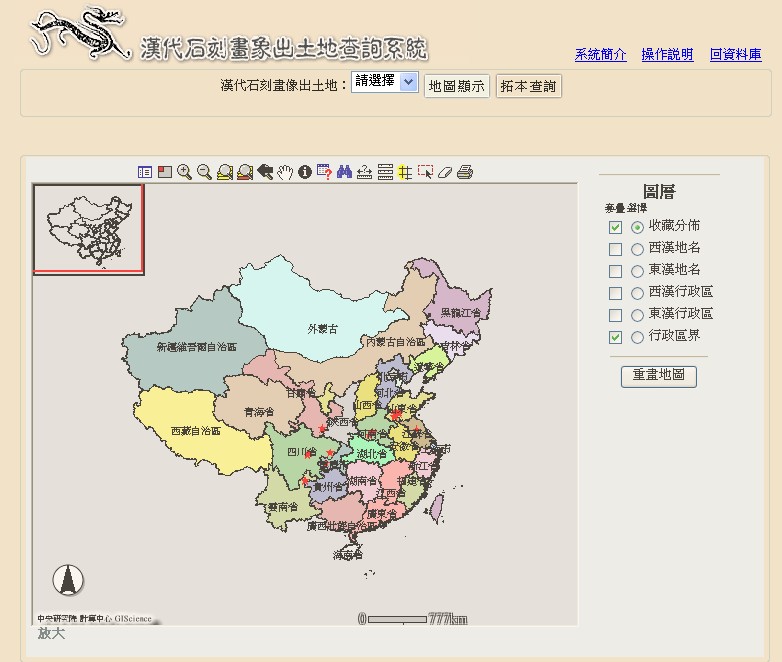 This website is the inquiry system for the sites of Han stone relief rubbings recorded in the database of Han Dynasty Stone Relief Rubbings.
http://webgis.sinica.edu.tw/website/stone1/
0
Digital Archives of Fu SSu-Nien Library
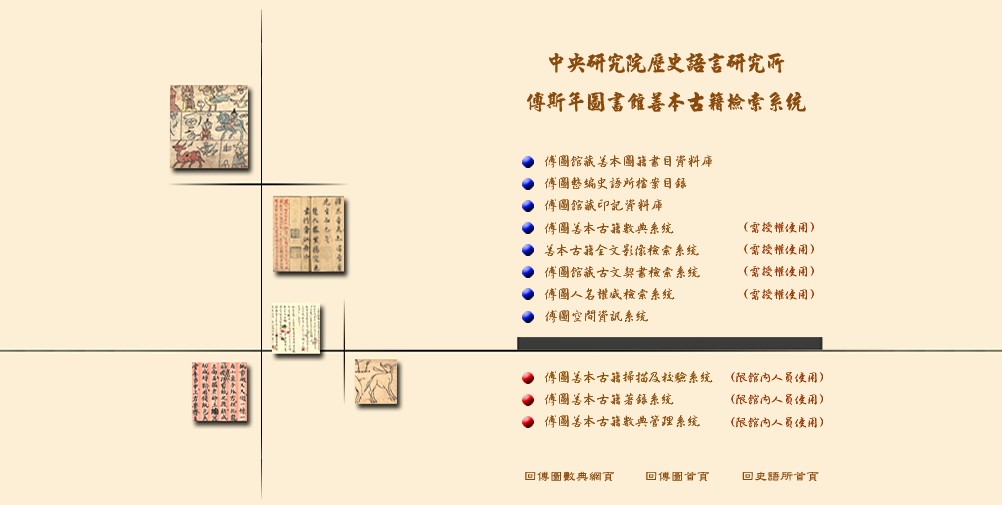 This website provides introduction and retrieval services of the following 13 databases in Fu SSu-Nien Library: Bibliographical Database of Rare Books and Pictures, Institute of History and Philology File Catalogue, Seal Database, Rare and Antique Book Digital Archives, Rare and Antique Book Image Retrieval System, Personal Name Authority File Retrieval System, Geospatial Information System, Database of Taiwan's Public and Private Collections of Historical Documents, Hui Jhou Contracts and Documents, Treasured Collections Digital Management System, Rare and Antique Book and Image Database, Rare and Antique Book Digital Archive Management system, Personal Name Authority File Database.
0
Database of Han Dynasty Stone Relief Rubbings
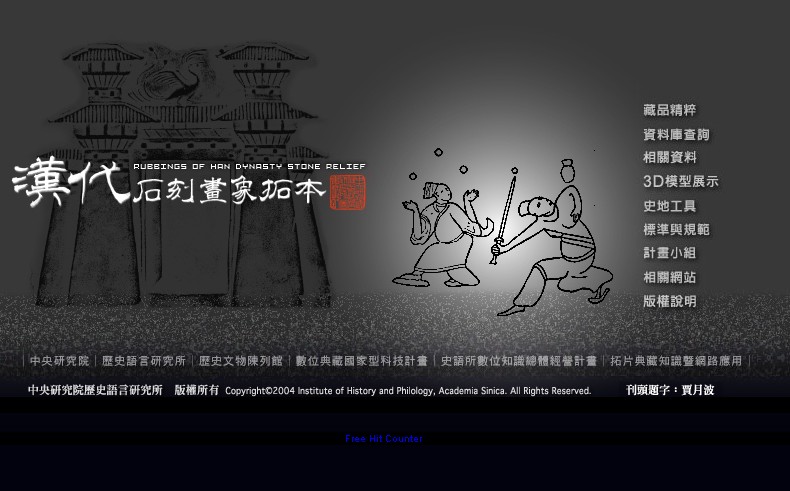 The main responsibility of this project is the digitalisation, management and promotion of more than 1,500 treasured Han Dynasty Relief Rubbings. The establishment of this digital database of precious rubbings would not only promote their use in academic research but also improve their preservation condition. The rubbings of the library originally come from shrines and tombs of Shandong, Hunan, S-chuan, Jiang-su, etc. As to their contents, in addition to the mythologies of deities, spirits, legendary animals, fortunate creatures, there are also accounts of social life such as architecture, horses and carts, industries, hunting and entertainment. Most of the rubbings were acquired by late fellows of the Institute, Fu SSu-Nien, Syu Jhong-shu,Doung Zuo-bin,Lao Gan and others by means of donation, exchange, purchase or field research from the founding of the Institute in 1928 to the Sino-Japanese War in 1937. Many rubbings in the library are rare and fine works of art, more beautiful and complete than other illustrated catalogues published so far in Taiwan and abroad. Furthermore, many original sculptures of these rubbings were destroyed or disappeared after the Cultural Revolution in China, these historical rubbings are therefore even move valuable especially for the study of the society, architecture and cultural life of the Han dynasty.
0
Map Inquiry System of Han Stone Relief Rubbings
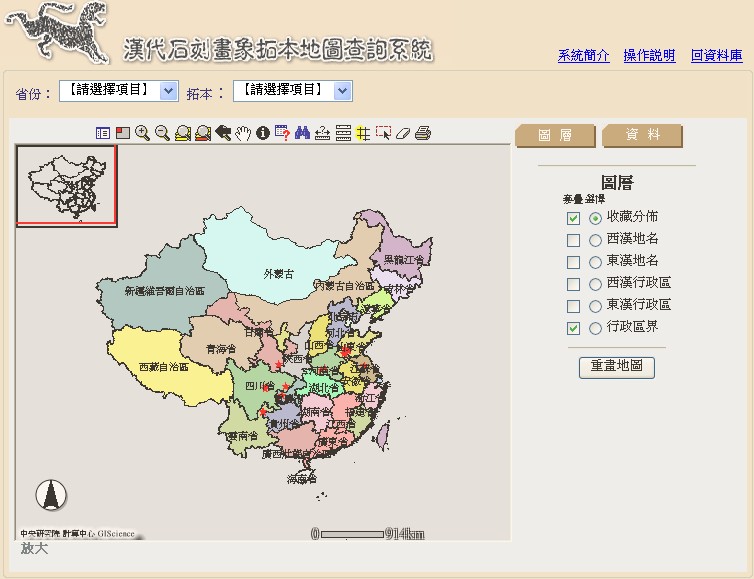 This website is the map inquiry system for the database of Han Dynasty Stone Relief Rubbings.
http://webgis.sinica.edu.tw/website/stone3/
0
Han Dynasty Historical Maps Inquiry System
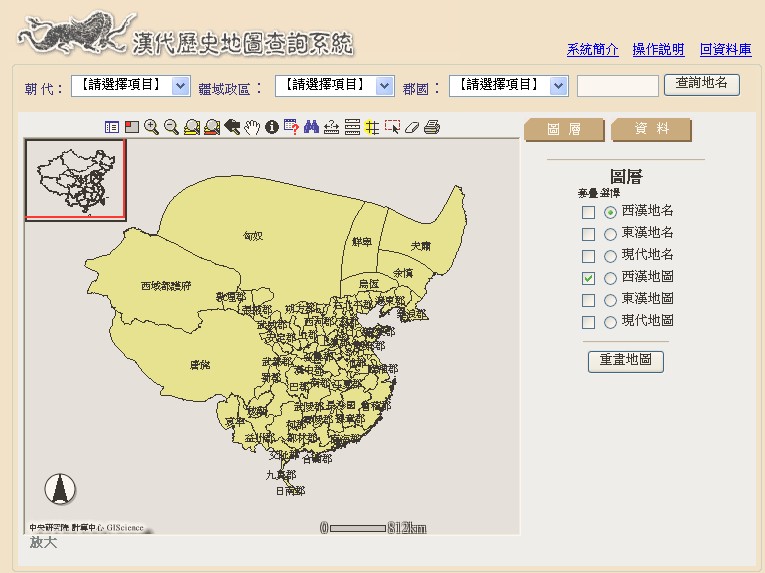 This website is the Han dynasty historical map inquiry system for the database of Han Dynasty Stone Relief Rubbings.
http://webgis.sinica.edu.tw/website/stone2/
0
Han Dynasty Wooden Slips Database
 This database is responsible for the management, revision and digitalisation of the Han Wooden Slips collected by the Institute of History and Philology, Academia Sinica. These wooden slips were excavated in areas that were once the frontiers of the Han dynasty. They are invaluable national cultural heritage, for they recorded in a direct and vivid style the various aspects of local social life such as its military, law, education, economy, religion and everyday life from the late middle period of the Western Han dynasty to the early Eastern Han dynasty. Considering the great value of computer technology to the study of Han dynasty wooden slip, the wooden slip team of the Institute launched the digitalisation plan of wooden slip image and commentary in the early 1990s. The team also established at the same time the infrared image system for the following two databases: Wooden, Silk, Bronze and Stone Objects, and A Supplement to Han Dynasty Wooden Slips from Edsengol. These were pioneering work in Taiwan at that time. Nowadays the digital archive project of the Han Wooden Slips in the Institute of History and Philology is working on the digitalisation of the wooden slip archive and then arranges the structure of its metadata after systematic analyse. This digital project will therefore transform these precious artefacts from their physical existence in the library into the virtual form of digital archives across the boundary of time and space. This wooden slip database allows users to browse the basic information of Han wooden slips, their commentary as well as different versions of digital images such as colourful, infrared photos . Besides, we also help the study of Han wooden slips by creating the inquiry system of Han dynasty wooden slips which incorporate the spatial and temporal information of the database with GIS.
0
Digital Archives Project for the Liao-Chin-Yuan Rubbings
 The Institute of History and Philology, Academia Sinica, has started the investigation of Fu SSu-Nien library's bronze and stone rubbings since 1995 while the Institute's collection of rubbings has been digitalised since 1990s with the launch of the National Digital Archives Program. Fu Ssu-Nine library holds about 2,000 rubbings of the Liao, Chin and Yuan dynasties. The Yuan rubbings (1260-1368) which are about 1,400 are the main part of our collection while the Liao rubbings (907-1125) are 160, and the Chin rubbings (1115-1234) are 450.
The library's rubbings are dated from 946 to 1382; however, the more exact dates of many of the rubbings are uncertain. As to their contents, these rubbings hold a wide variety of subjects including tomb inscription, headstone, carved scripture, statute, title, poetry and lyrics, Daoism, Buddhism, imperial edict, decree, law. Besides, Qidan, Jurchen and Mongolian languages which were all official languages during the Liao, Chin, or Yuan dynasties were used as commonly as the Han language. Documents and literature of those three dynasties were therefore written not only in Han but also in Qidan, Jurchen, or Mongolian. Though Fu SSu-Nien library holds only about 200 non-Han rubbings, which do not form a substantial collection, they are precious and very important materials for the study of rhyme in the Middle Age of China and the history of the Liao, Chin and Yuan dynasties.


 visits (since January 2011)